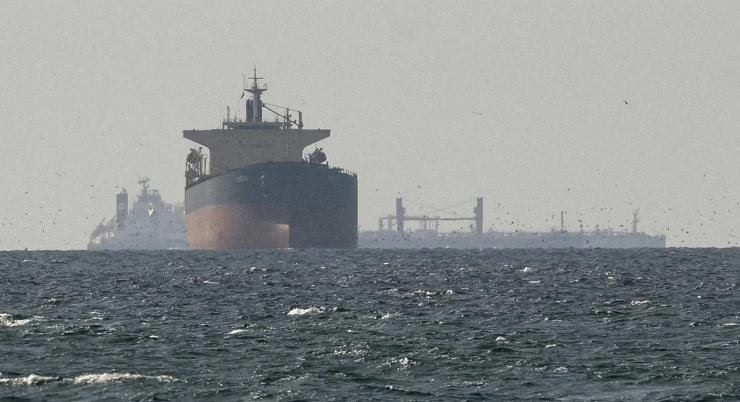
Donald Trump on Sunday announced that the United States Navy would swiftly enforce a blockade on vessels entering or leaving the Strait of Hormuz, following the collapse of ceasefire talks between the United States and Iran in Pakistan.
The United States Central Command (CENTCOM) confirmed that the blockade of Iranian ports would commence on Monday at 10 a.m. EDT (5:30 p.m. in Iran), stating that enforcement would apply “impartially against vessels of all nations.” However, ships transiting between non-Iranian ports would still be allowed passage through the vital waterway.
The move is aimed at weakening Iran’s strategic leverage, as the strait previously accounted for about 20 percent of global oil shipments before the conflict disrupted traffic.
Although limited activity has resumed since the ceasefire, with over 40 commercial vessels crossing, analysts warn that the blockade could further destabilize global energy markets.
Trump, speaking to Fox News, insisted the measure would be absolute, declaring, “It’s going to be all or none.”
In a social media post, he directed the Navy to “seek and interdict every vessel in international waters that has paid a toll to Iran,” warning that such ships would not be granted safe passage.
Despite the announcement, Iran’s Islamic Revolutionary Guard Corps maintained that the strait remains under its “full control,” allowing civilian vessels to pass while warning of a “forceful response” to military ships.
The blockade proposal has drawn skepticism. Andreas Krieg of King’s College London described the plan as unrealistic, arguing that Washington lacks the necessary military leverage to enforce such a move without concessions.
The breakdown in negotiations, held over 21 hours, marks the highest-level engagement between the two countries since the 1979 Islamic Revolution.
The US delegation, led by Vice President JD Vance, demanded firm guarantees that Iran would not pursue nuclear weapons, alongside conditions including ending uranium enrichment, dismantling facilities, reopening the strait, and halting support for regional armed groups.
Iranian officials rejected what they described as excessive US demands. Parliament Speaker Mohammad Bagher Qalibaf warned Washington, saying, “If you fight, we will fight,” while adding that progress had been made and urging the US to build trust.
Efforts to revive dialogue are ongoing. Ishaq Dar said Pakistan would facilitate further talks, while the European Union and Oman called for renewed diplomacy. Meanwhile, Vladimir Putin expressed readiness to support a negotiated settlement.
Tensions over Iran’s nuclear program, long denied by Tehran as military in intent, remain central to the crisis, dating back to the 2015 Iran Nuclear Deal, from which Trump withdrew the US during his presidency.
The conflict, which began on 28 February, has caused widespread devastation across the region, with thousands of casualties reported in Iran, Lebanon, Israel, and Gulf states, alongside significant infrastructure damage.
With the ceasefire set to expire on 22 April, uncertainty looms over whether diplomacy can prevail or the conflict will escalate further.
(France 24)