Danjuma Babaji received neither salary nor pension for nine months after retiring from the Bauchi State public service in November 2022.
With no access to his retirement benefits and many dependents to support, he survived by tending a small farm and rearing livestock. “It was really tough,” he said. “I don’t know anyone here, and I didn’t give a bribe to anyone; I waited”, he said.
Pensioners sometimes pay a bribe to expedite the processing of their payments.
Babaji eventually began receiving a monthly pension in July 2023. His gratuity worth N3.7 million remains unpaid.
For Adamu Ibrahim, who retired in 2017, the waiting has stretched into years. He said he spent eleven months after retirement without income before his pension started.
Now older and frequently ill, he depends on his children for food and medication. “After giving my productive years to the service of the state,” he said, “I am still waiting for what is mine.”

Government payments are supposed to be documented at every step, from request to approval, voucher, and receipt.
These records separate legal spending from money that goes missing. Without them, it becomes impossible to hold anyone accountable.
The experiences of Babaji and Ibrahim are not isolated cases. They sit at the end of a public finance system in which money is released without documentation, approvals are bypassed, and records go missing, patterns WikkiTimes unearthed in the Bauchi State Auditor-General’s reports.
WikiTimes reviewed the Bauchi State Auditor-General’s reports for major ministries and executive offices. The findings show how quickly missing paperwork can lead to questionable government spending.
The Auditor General’s report for Bauchi State’s 2024 accounts revealed widespread failures in financial accountability, affecting both ministries and top officials.
The audit found that substantial sums of public money were spent without the required legal documentation to demonstrate their purpose or legitimacy.
For example, auditors found that the Office of the Chief of Staff and key ministries spent public money without proper documentation
According to the report, N182,857,491 was spent without supporting documents. A separate finding in the audit report indicated that N104,500,000 was paid without approval, and N261,712,376 was disbursed without the authorisation of the Accounting Officer, in breach of “Financial Regulation No. 0603 of 2001.”
At the Office of the Chief of Staff alone, more than half a billion naira was expended without recourse to due process.
Dr. Aminu Gamawa is the Chief of Staff to the Bauchi State Government. A trained lawyer at Harvard Law School, Dr. Gamawa earned postgraduate law degrees and conducted research and policy analysis on governance, the rule of law, and public institutions.
Before assuming his current role, he served as Bauchi State Commissioner for Budget and Economic Planning.
Long before entering government, Gamawa was a well-known public commentator on platforms such as the BBC, DW Radio, and Al Jazeera, where he consistently voiced opposition to corruption in Nigeria.
In a Facebook post from 2014, he stated that he was “against corruption, corrupt leaders and corrupt practices,” adding that he supported “transparency and accountability.”
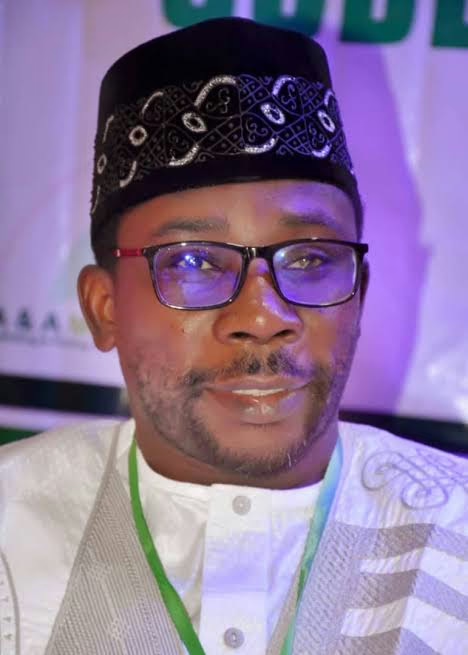
At the Ministry of Finance, auditors found that N38,071,686.50 was paid without proper documentation, contrary to Financial Regulation No. 0704, which requires that all payments be supported by relevant documentation before disbursement.
The audit did not record vouchers, receipts, or other records sufficient to verify the expenditure.
Dr. Yakubu Adamu is the Bauchi State Commissioner of Finance. The audit findings at his ministry will raise further questions, given his continued detention by the Economic and Financial Crimes Commission, EFCC.
Adamu was allegedly being held in connection with a N4.6 billion fraud dating back to 2023 and alleged terrorism financing.
While the audit itself identifies institutional “undocumented payments,” the documentation of missing vouchers and unapproved spending at his ministry raises further questions about his credibility and the manner in which his ministry is supervised.
Similar findings were recorded at the Ministry of Budget, Economic Planning, and Multilateral Coordination, where N11,716,750 was paid without proper documentation.
At the Ministry of Women Affairs, auditors documented N17,210,000 paid without supporting records. In each case, the audit language was consistent.
Payments were made, but the documentation required to verify their authenticity was absent.
The Ministry of Religious Affairs was also flagged in the audit report. According to the audit, N22,691,352 was paid without any supporting documents to verify the payments.
Without these documents, auditors noted, it was not possible to determine the purpose of the expenditure or confirm the beneficiaries.
Established to promote moral guidance and ethical conduct in public life, the ministry appears in the audit as a custodian of faith, preaching righteousness. At the same time, its expenditures left no trace.
In the Ministry of Education, the figures were significantly higher. Auditors recorded N121,681,853 in payment vouchers for payments made without supporting documentation.
In addition, vouchers worth N15,263,553.54 were not presented for audit scrutiny, in violation of Section 125 of the Constitution of the Federal Republic of Nigeria and the Bauchi State Public Sector Audit Law of 2021.
When vouchers are not presented for audit, the audit process itself is compromised, as auditors cannot verify expenditure after the fact.
The Ministry of Housing and Environment recorded some of the largest figures in the report. Auditors documented N565,276,040.32 paid without acknowledgement receipts.
Acknowledgement receipts serve as evidence that funds reached their intended recipients. Without them, auditors could not confirm whether the payments achieved their stated purpose.
The 2024 audit report identified several financial breaches at the Bauchi State Ministry of Culture and Tourism.
Auditors recorded N2,590,000 as paid for work that was not executed. Another N2,795,000 was paid without retirement documents.
The report also flagged N2,000,000 supported by a fake acknowledgement receipt, and N2,642,000 described as diverted funds with a phony receipt attached.
Other ministries showed variations of the same problem.
At the Ministry of Agriculture, auditors identified payments made without approval, payments without supporting documents, and N3,573,000 paid using fictitious receipts.
The use of fictitious receipts, as noted in the audit, meant that fake documents were presented to justify payments.
At the Ministry of Health, auditors recorded two different categories of violations.
First, N265,623.64 in taxes due was not deducted or remitted to government coffers, contrary to tax laws.
Second, N167,349,286.04 was paid as unentitled salaries and allowances, in violation of public finance rules.
The audit findings also show that the Bauchi State Pension Board was involved in multiple questionable transactions.
These include N23,556,392.10 paid as gratuity and five years’ pension without approval, N14,438,640.14 in unremitted loan deductions, and N354,701,864.27 arising from discrepancies between the receipt cash book and bank statements.
At the Bauchi State Destination Hotel, N16,200,000 earned between February 2023 and February 2024 was not remitted to the government as required under the lease agreement.
At the Bauchi State Oil and Gas Academy, Alkaleri, N1,642,320 in revenue due to the state for 2024 was similarly unremitted. Auditors also cited N700,000 paid by the Bauchi State Mining Synergy and Exploration through vouchers without supporting documents.
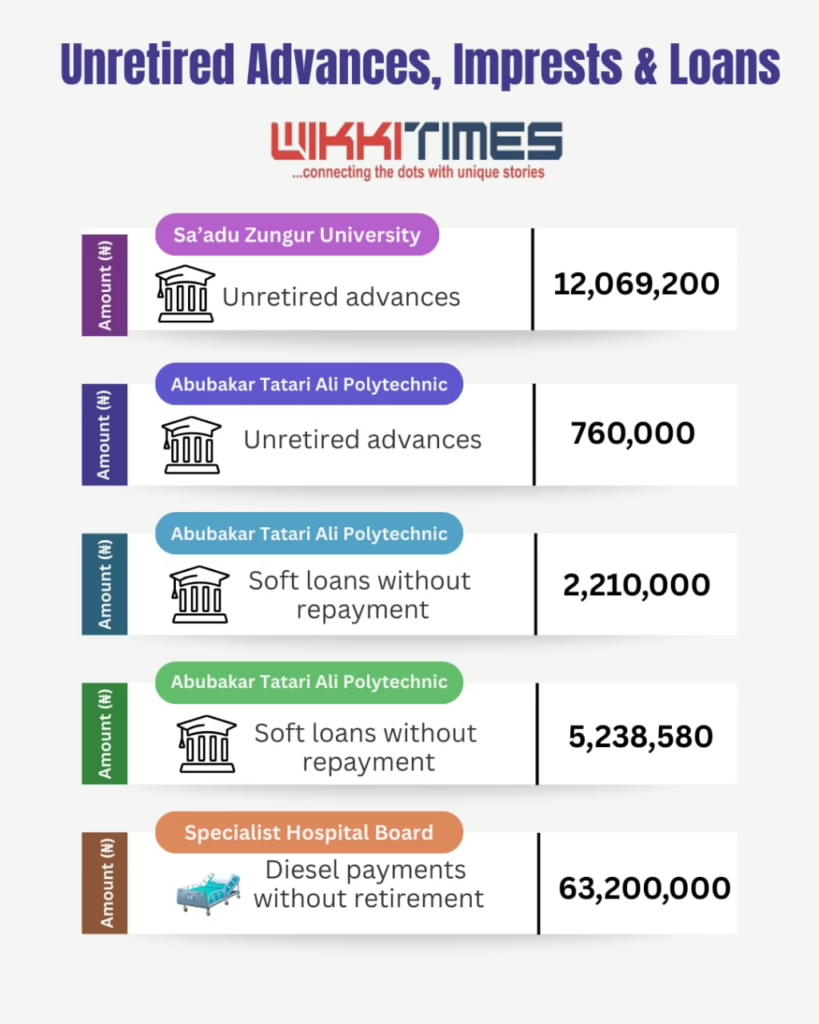
The audit queries, grounded in various financial regulations, highlight serious lapses in approval procedures, remittance practices, and basic financial record-keeping by the board.
Audit figures alone do not explain how payments without approvals, documentation, or evidence of execution move through government systems.
Aminu Tukur, a former member of the Bauchi State House of Assembly, said the audit exposes a legislature that has abandoned its constitutional duty.
The House has become “just a mere rubber stamp or an arm of the executive that can be used at any given time,” he said, recalling how the same expenditure once appeared simultaneously in submissions from the Ministry of Education, the Ministry of Higher Education, and the SSG’s office. Such duplications, he noted, only fail when lawmakers insist on scrutiny.
He said if there is proper parliamentary responsibility, “all the wrongdoing will be checked”, but regretted that, “the lawmakers are just after their own personal benefit rather than the collective interest of the citizens of Bauchi state.”
The Speaker of the Bauchi State House of Assembly declined to comment. Several calls and WhatsApp messages sent to him were ignored.
Seun Justin O., the executive director of Young Leaders Network, an organization that has worked with the Bauchi State government at different levels to strengthen transparency and accountability, said the deeper failure begins after audits are published.
“Audit reports seem to only be on paper and not fully implemented”, he said. Highlighting the lack of consequences for financial irregularities, he asked, “How many of those prosecutions have we seen happen in Bauchi State year in, year out because of these malpractices in financial appropriations in the state?
Interviews conducted by WikkiTimes with serving civil servants directly involved in voucher processing and payment approvals help explain how these control failures occur in practice. Both officials requested anonymity for fear of retaliation.
One of the officials, who worked on payment vouchers and preliminary approvals at Government House, said scrutiny often ended once files carried the expected signatures.
“Once the voucher leaves my desk with the right signature, nobody asks how it started,” he said.
According to him, documents were sometimes prepared for projects that had not been executed. “If the file looks clean and moves fast, people assume the work was done,” he added.
At the Ministry of Finance, another official involved in processing payment releases described how figures were adjusted and approvals granted on the basis of submitted paperwork.
“Due process slows things down. What they want is approval, and that’s exactly what I give them,” he said.
Rules on paper, breaches in practice
The audit shows a clear gap between public finance rules and how they are actually followed. Nigeria’s financial regulations explain how to approve, document, and audit spending, so that public money can be tracked at every step.
The audit report cited Financial Regulation No. 0704, which requires that relevant documents support all payments before funds are released.
Yet auditors repeatedly found payments processed without such documents across multiple ministries. Financial Regulation No. 0603 requires Accounting Officer authorization for expenditure.
This safeguard was disregarded in payments amounting to hundreds of millions of naira at the Office of the Chief of Staff.
WikkiTimes investigation found that approval processes also failed at multiple points. Payments without approval were recorded not only at the Office of the Chief of Staff but also at the Sustainable Development Goal Office, where N28,856,050 was paid without approvals attached to authenticate the payments.
Similar findings were recorded across other MDAs, suggesting that approval procedures were either bypassed or not enforced.
Audit findings further show that the Bauchi State Agency for Persons with Disabilities paid N4,759,500 without proper supporting documentation. At the Ministry of Education, vouchers worth more than N15 million were not presented for audit.
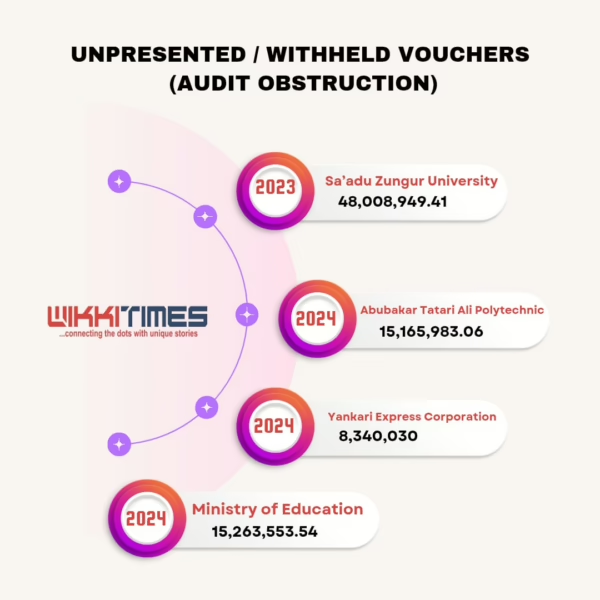
When vouchers are withheld, auditors cannot confirm whether payments complied with regulations, undermining the accountability process.
WikkiTimes found many cases in the audit report where auditors raised concerns that were never resolved.
The report lists the violations, but does not show that any money was returned, approvals were later obtained, or penalties were given during the audit period.
The failures were mostly due to poor procedures: payments were made without documents, approvals were skipped, and audit rules were ignored.
At Government House, auditors found N22,125,200 and another N11,130,000 in payments recorded as “unreceipted”. In addition, N10,995,200 was paid without supporting documents.
In each instance, the audit noted the absence of receipts or records showing how the funds were used. In audits, payments without receipts are a serious violation of the rules.
Without receipts or proof, auditors cannot tell if the money reached the right people or was used as intended.
In several instances, particularly those involving missing vouchers or a lack of documentation, the issues remained unresolved at the time of the audit.
The report does not show that any of the disputed amounts were recovered, corrected, or penalized during the audit period. Because of this, many issues are still unresolved in the public accounts.
A repeated pattern
WikiTimes’ previous reporting has documented a long-standing pattern of corruption in Bauchi State. For instance, in September 2024, WikkiTimes reported that the Office of the Secretary to the State Government spent more than N29 billion within six months, exceeding its approved annual budget and raising questions about budgetary control.
The same SSG office also spent another N67.38 billion on the security vote, exceeding the combined capital expenditure for education and healthcare over the four years under review.
In July 2025, WikkiTimes reported that another N17.4 billion was spent on security votes, consultancy, welfare, and related items within three months, with limited public detail on how the funds were allocated.
Speaking during an interview on Channels TV, Bauchi State Governor Bala Mohammed confirmed WikkiTimes’ previous investigations, describing his former SSG as “fraudulent.”
Our reporting found that most of the expenditures were outside government-approved budgetary provisions.
The 2024 Auditor-General’s report officially confirms a pattern of unclear spending, poor controls, and ongoing corruption in government.
WikkiTimes sought official responses from the Bauchi State Government on the audit findings. This medium contacted Muktar Gidado, Special Adviser to the Governor on Media, and Abdulwahab Mohammed, Senior Special Assistant on Communications.
The duos ignored repeated calls and messages. WikkiTimes also sent a Freedom of Information (FOI) requests to Usman Shehu Usman, the Bauchi State Commissioner for Information, and to Alhassan Dambam, the Chief Press Secretary to the Governor. They also ignored WikkiTimes. Separate reminders were sent, but were ignored as of press time.
Editor’s note: In Part two of this series, we shifts the spotlight from ministries to Bauchi’s higher institutions and parastatals, revealing how bodies meant to model discipline instead lost paper trails, ignored controls, withheld revenue, and spent billions through forged vouchers
This report is produced with support from Civic Media Lab.