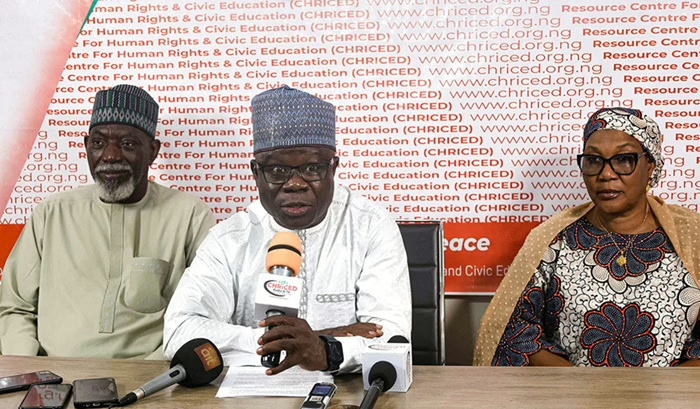
Nigeria’s Centre for Human Rights and Civic Education (CHRICED) has painted a grim picture of the nation’s state in 2025, warning that worsening economic hardship, governance failures, insecurity and shrinking civic space pushed millions of Nigerians to the brink, while political leaders remained largely insulated from the suffering of the people.
Speaking at an end-of-year media briefing to mark the beginning of 2026, CHRICED Executive Director, Comrade Ibrahim M. Zikirullahi, said the past year tested Nigerians “in the harshest ways,” with rising poverty, deepening inequality, and a democratic system increasingly under stress.
According to him, the past year tested Nigerians in ways that echo the timeless words of Charles Dickens: “It was the worst of times… it was the age of foolishness.” Yet, even in the midst of hardship, Nigerians demonstrated a resilience that defies despair.
The year began with hope, hope that the lessons of 2024 would compel our political leaders to govern with empathy, prudence, and accountability.
Instead, citizens were met with deepening hardship, widening inequality, and a political class increasingly insulated from the suffering of the people.
Across the nation, families battled soaring prices, shrinking incomes, and a cost‑of‑living crisis that pushed millions to the brink. Inflation continued its relentless climb.
The Naira weakened further. Jobs disappeared. Public services deteriorated. Hunger tightened its grip on households already stretched beyond endurance.
Yet, in the face of these storms, Nigerians endured. As Maya Angelou reminds us, “Still, like dust, we rise.”
The Economy: A Nation Struggling to Breathe
The economic realities of 2025 did not merely challenge Nigerians; they suffocated them. Inflation continued to eat away at the value of every Naira, turning basic survival into a daily battle.
Even when official figures suggested a slowdown, the lived experience of ordinary citizens told a different story: prices remained brutally high, wages remained stagnant, and the erosion of purchasing power continued unchecked.
Transportation costs soared. Medicines slipped out of reach. Essential goods became luxuries.
Families were forced into impossible choices, which meal to skip, which bill to ignore, which dream to abandon.
Even though the prices of some food items, especially grains, may have dropped, many poor Nigerians are still unable to afford them due to lack of income.
While the government celebrates these partial price reductions, farmers are counting their losses, as there has been no holistic approach to addressing the high cost of fertilizers, transportation, and labour.
Experts warn that this situation could discourage many farmers from returning to the fields next season, a looming threat that could deepen hunger and destabilize food security across the country.
The naira’s weakened value has kept imported goods, and even many locally produced items, painfully expensive.
The ripple effect is devastating: small businesses are collapsing, children are withdrawn from schools, households are shrinking their diets, and communities are sliding deeper into poverty.
Instead of offering relief, government policies often intensified the suffering. Higher taxes, rising bank charges, and inconsistent economic directives created confusion for businesses and despair for citizens.
The so‑called “reforms” became a burden carried almost entirely by the poor, while those in power remained insulated from the consequences of their decisions.
Chinua Achebe’s words echo with painful clarity: “When suffering knocks at your door and you say there is no seat, it tells you not to worry because it has brought its own stool.”
In 2025, government-induced suffering did not just bring its own stool, it made itself a home in the lives of millions.
And unless political leaders act with courage and conscience, 2026 risks becoming another year where Nigerians are asked to endure what no society should ever normalize.
Governance: Extravagance in the Midst of Scarcity
2025 exposed, yet again, the widening moral gulf between those who govern and those they claim to serve. While citizens tightened their belts to survive, government officials loosened theirs to indulge.
Extravagant spending, inflated budgets, and tone‑deaf priorities became the defining features of governance. Leaders preached sacrifice but practiced excess. They demanded patience from the people while refusing to restrain their own appetite for luxury.
The Oronsaye Report, a long‑standing blueprint for reducing the cost of governance, remained buried under political convenience.
Instead of streamlining government, new agencies, committees, and appointments multiplied, consuming scarce resources that should have been directed toward lifting citizens out of poverty.
This contradiction is not just irresponsible, it is immoral.
A government that asks the poor to endure hardship while expanding its own privileges is a government that has lost its moral compass.
Nigeria cannot continue to bleed resources into a system designed to enrich the few at the expense of the many. The people deserve leadership that sacrifices first, spends wisely, and governs with conscience.
Elections and Democracy: A System in Distress
The off‑cycle elections of 2025 once again exposed the fragility of Nigeria’s democracy.
Reports of voter suppression, violence, ballot manipulation, and compromised institutions cast a long shadow over the electoral process.
Local government elections across many states were reduced to coronations for ruling parties. The absence of genuine competition undermines democracy and erodes public trust.
The judiciary, once revered as the last hope of the common man, continued to struggle under the weight of public scepticism. Inconsistencies in judgments, allegations of corruption, and the perception of political capture further weakened confidence in the courts.
As George Orwell warned, “In a time of deceit, telling the truth is a revolutionary act.”
Nigerians who speak truth to power, activists, journalists, and civic leaders, continue to face intimidation, harassment, and repression.
Nigeria’s Accelerated Drift Toward a One‑Party State in 2025
The year 2025 witnessed an alarming acceleration in Nigeria’s drift toward a de facto one‑party state.
The wave of defections from opposition parties to the ruling party, particularly the mass defection of lawmakers and governors, signalled a dangerous erosion of political pluralism.
This trend, already visible in 2023 and 2024, intensified in 2025 as opposition legislators across the National Assembly abandoned their mandates to align with the ruling party.
This consolidation of political power undermines the very foundation of Nigeria’s democracy. A healthy democracy requires competition, dissent, and ideological diversity.
Instead, Nigeria is witnessing a political landscape where dissent is punished, opposition is weakened, and political survival increasingly depends on allegiance to the ruling party.
The consequences are profound:
- Reduced accountability, as the ruling party faces little institutional resistance.
- Judicial vulnerability, as courts become susceptible to political influence.
- Electoral manipulation, as seen in off‑cycle elections where ruling parties swept all local government seats.
- Public disillusionment, as citizens lose faith in the possibility of meaningful political change.
This trend is not speculative, it is observable, measurable, and dangerous. If left unchecked, Nigeria risks sliding into a political order where elections exist only in form, not substance.
Insecurity: A Nation Under Siege
Despite massive allocations to defence and security, Nigerians remain trapped in fear. Kidnappings, banditry, insurgency, and violent crime continued to ravage communities across the country.
From highways to farmlands, from schools to marketplaces, from Churches to Mosques, insecurity tightened its grip, leaving citizens traumatized and exhausted.
Farmers abandoned their fields. Students were abducted or forced out of school. Businesses relocated or shut down. Entire communities were displaced. The human and economic toll is staggering, and unacceptable.
The government’s constitutional duty is clear: protect lives and property.
Yet, year after year, Nigerians bury loved ones, pay ransoms, and live behind barricaded doors while officials issue recycled promises and hollow assurances. Security cannot be a slogan. It must be a priority backed by competence, accountability, and political will.
A nation that cannot guarantee safety cannot guarantee development. Nigeria cannot rise while its citizens live under siege.
Shrinking Civic Space: Silencing the Voices of the People
Instead of confronting insecurity with urgency, the state turned its attention to silencing dissent. The civic space shrank further in 2025. Peaceful protesters were arrested.
Activists were harassed. Journalists were intimidated. Civil society organizations faced new regulatory pressures designed to weaken their voice and restrict their work.
This systematic narrowing of civic space is not accidental, it is deliberate. It reflects a growing fear of dissent and a desire to silence those who dare to question power. But a democracy without dissent is a democracy in name only.
When citizens are afraid to speak, when journalists are punished for reporting the truth, when activists are targeted for defending rights, the nation loses its moral anchor.
Civic space is the heartbeat of democracy. Without it, accountability dies, corruption thrives, and tyranny grows.
Nigeria cannot afford to drift into authoritarianism under the guise of “order” or “regulation.” The right to speak, to organize, to protest, and to hold leaders accountable is non‑negotiable. It is the lifeblood of a free society.
Nigeria is at a crossroads
Across all these fronts — the economy, governance, security, and civic freedoms, one truth stands out: Nigeria is at a crossroads.
The choices made in 2026 will determine whether the country continues down a path of hardship, repression, and inequality, or whether it rises to reclaim the promise of justice, dignity, and shared prosperity.
The Nigerian people have shown extraordinary resilience. But resilience is not enough. It is time for courage, from leaders and citizens alike. It is time to demand accountability, insist on transparency, defend civic freedoms, and refuse to normalize suffering.
Nigeria cannot rise on the backs of a silenced people. It cannot progress while millions are hungry, unsafe, unheard, and unseen. The future will not change unless citizens insist on change.
The message of 2025 is clear: the people are suffering, the system is failing, and silence is no longer an option.
A Call to Leadership: 2026 Must Be a Year of Courage
Nigeria cannot continue on this path. The government must:
- Reduce the cost of governance and implement the Oronsaye Report.
- Prioritize agriculture, manufacturing, and local government–driven development.
- Reform the judiciary and security institutions.
- Strengthen INEC and restore public trust in elections.
- Protect civic freedoms and uphold the rule of law.
- Address wage inequality and ensure fair compensation for workers.
- Tackle corruption decisively and transparently.
These are not suggestions — they are necessities.
A Call to Citizens: Our Future Depends on Us
Nigerians have shown extraordinary resilience. But resilience alone is not enough. We must transform endurance into action.
As Nelson Mandela said, “It is in your hands to make a better world for all who live in it.”
In 2026, citizens must:
- Hold leaders accountable.
- Refuse to sell their votes.
- Demand transparency.
- Defend their rights.
- Stand united against impunity.
Democracy survives only when citizens refuse to surrender their power.
Conclusion: Hope Is Not Lost
Despite the trials of 2025, we stand here, unbroken, unbowed, and unafraid. Like Okonkwo in Things Fall Apart, who survived the worst year in living memory, Nigerians can say:
“Since we survived that year, we shall survive anything.”
But survival is not enough. We must build. We must reform. We must rise.
As we step into 2026, let us remember Mandela’s enduring words:
“It always seems impossible until it is done.”
Nigeria can rise. Nigeria will rise. But only if citizens stand firm, demand accountability, and refuse to surrender their rights.
To every Nigerian who endured 2025, know this:
You are stronger than the hardship you survived.
And together, we will build a nation worthy of its people.
Finally, CHRICED thanks the media, civil society partners, international partners, and all Nigerians for their steadfast support.
May 2026 bring renewed strength, clarity, and collective resolve as we work toward the nation we dream of.
May 2026 be the year Nigeria turns the page.