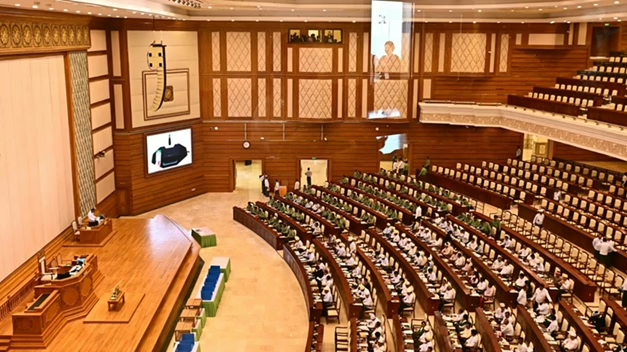
Myanmar’s parliament met yesterday for the first time since the 2021 coup, following controversial multi-phase elections that were dominated by the country’s pro-military Union Solidarity and Development Party (USDP).
According to a report in the state-run Global New Light of Myanmar, 337 lawmakers attended the first session of the 440-seat Pyithu Hluttaw (lower house), which elected Khin Yi, the chairman of the USDP, as parliamentary speaker.
A former general and police chief, Khin Yi, is widely regarded as a close ally of Senior Gen. Min Aung Hlaing, the head of the Myanmar military, who led the 2021 coup and has ruled the country since.
The chamber also elected Maung Maung Ohn, the current minister of information, as its deputy speaker.
In an address to the chamber, Khin Yi described the convening of the parliament as a “historic and proud day” – one that reflected “the aspiration of the entire population for the development and establishment of a multiparty democratic system.”
He added, “I would like to urge all Hluttaw representatives to join hands with one another in unity and harmony, focusing on the interests of the State and the people.”
The opening of the new parliament followed a three-phase election in December and January that was widely criticized as a sham exercise designed to divide the opposition to military rule and secure the military’s domination of Myanmar’s politics.
Due to the civil war, elections couldn’t be held in large parts of the country, and 67 seats in the Pyithu Hluttaw have not yet been filled.
Nonetheless, in the absence of significant opposition and aided by the strict control of the media, the USDP won 231 of the 264 seats up for grabs in the Pyithu Hluttaw and 108 of the 157 contested seats in the upper house (Amyotha Hluttaw).
A quarter of the seats in each house are reserved for the military, giving the military and its allies full control over the constitution and direction of the next government. The remaining seats were won by 21 other smaller parties.
The Amyotha Hluttaw is scheduled to hold its first session tomorrow, followed by state and regional legislatures on 20 March 2026.
The two houses of parliament will then convene and choose a president who will form a government that is expected to take office in April.
To ensure “continuity” in who dominates Myanmar’s politics, the junta has passed a law creating what it called the Union Consultative Council, a five-member body that is intended to oversee both the military and civilian administrations.
It is widely expected that Min Aung Hlaing will use such a body to maintain his control over both the military and the civilian administration, whether or not he takes the post of president, something that he is rumored to have coveted for years.
Min Aung Hlaing has planned for such a “transition” since his seizure of power in 2021, hoping that it will create a means of reducing the intensity of the current conflict and normalize the junta’s relations with the outside world.
However, the military was forced repeatedly to delay the holding of elections due to the deteriorating security situation in much of the country.
The election and the transition that it has initiated have both been condemned by opponents of the military, human rights groups, and most independent observers.
“Before the election, Human Rights Watch described the polls as a ‘desperate bid for international legitimacy after nearly five years of brutal military repression.”
In a statement yesterday, the Special Advisory Council for Myanmar, an independent group of international experts, denounced what it described as the junta’s “absurd rebrand.”
“If Min Aung Hlaing thinks a rebrand will offer him a way out, he is sorely mistaken,” said SAC-M’s Chris Sidoti. “States must outright reject the junta’s puppet government and refuse to engage with it.”
How the outside world reacts to the change remains to be seen. Western governments are unlikely to be taken in by the electoral makeover, but it could be enough to normalize Myanmar’s relations with its immediate neighbors, including the Association of Southeast Asian Nations (ASEAN).
ASEAN has not recognized the election results, but during a meeting of the bloc’s foreign ministers in January, Philippine Foreign Secretary Ma.
Theresa Lazaro expressed optimism that “something positive” might emerge from the transition to a “civilian” government.
(The Diplomat)