As stakeholders continue to re-examine key policies governing natural resource governance in the Niger Delta, president of the Movement for the Survival of Ogoni People, MOSOP, Engineer Wai-Ogosu has reiterated the urgent need to simplify and reform the Petroleum Industry Act, PIA to offer a truly inclusive environment that will serve the people better and improve the Nigerian government’s image as a government that cares.
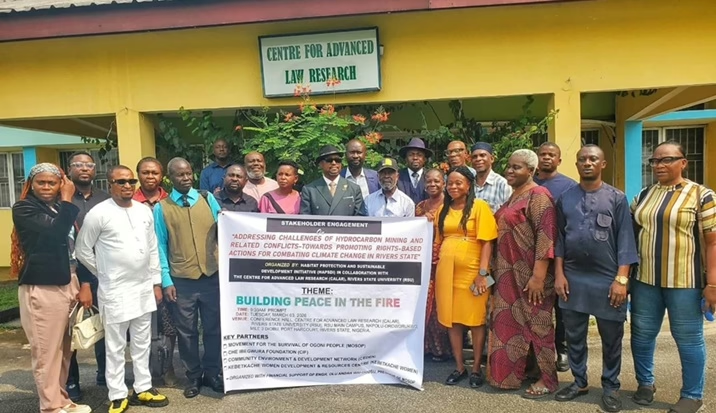
The president made the call in an opening remark as chairman at a one-day high level dialogue that brought academics, civil society and oil impacted community members together in Port Harcourt organized by Community Environment and Development Network in collaboration with other organizations recently in Port Harcourt.
He stated: “We must simplify and reform the PIA to ensure a rapid, equitable, and sustainable collaboration between host communities and the Federal Government”, Engr. Wai-Ogosu charged, expressing hope that a justice-focused petroleum law in Nigeria will offer a ‘truly inclusive’ atmosphere that would repair Nigeria’s image as a state who, for many years, was presiding over violent and hostile extractive operations against its citizens.”
Critical areas of concerned have been raised by several groups over the PIA challenging its potential to effectively address the interests of host communities if not revisited.
The MOSOP leader advocated for a Nigerian state that prioritizes “our local communities’ interest” in line with global mandate for states to protect and enforce respect compliance for the non-negotiable, inalienable rights of its citizens”.
Expressing the confidence that the engagement will serve as a “springboard for the urgent and necessary overhaul of the Petroleum Industry Act”, the MOSOP President thanked the organizers, HAPSDI team, led by Mr. Menidin Paul Egbo and Mr. Collins Lebeteh Kenneth, for their felt passionate advocacy and strategic initiatives in collaborating with CARL and other partners to address issues of grave concern.
Prof. Ibibia Lucky Worika, Director, Centre for Advanced Legal Research at Rivers State University (RSU) in Port Harcourt, in a keynote address at the event called for stronger implementation of legal and policy frameworks to address decades-long conflicts and environmental challenges facing the Niger Delta region.
Highlighting key provisions of extant frameworks that emphasize compliance with standards of practice in operations of corporate investments, Prof. Worika explained that such provisions were designed to combat extractive industry-related conflicts and promote sustainable investment in the global community.
His presentation, titled: ‘Addressing the Challenges of Hydrocarbon Mining and Related Conflicts: Towards Promoting Rights-Based Actions for Combating Climate Change in Rivers State,’ noted that pollution and environmental degradation in the Niger Delta region of Nigeria have regrettably become notably widespread and well-documented.
He commended the focus of the one-day engagement as one that positions deliberations on the role of Nigeria in the implementation of international legal frameworks for guiding oil extraction operations around safeguarding the environment and promoting corporate responsibility.
Worika called for protection and respect for human rights across the length and breadth of Nigeria.
He noted that the Constitution of the Federal Republic Nigeria did not, as yet, expressly provide for enforceable environmental rights, even though the African Charter on Human and Peoples’ Rights contained provisions on environmental rights enforcement which when necessary, the courts could freely uphold.
Prof. Worika urged multinational oil companies operating in the Niger Delta region to comply with established international norms, including the provisions of the Organization for Economic Co-operation and Development’s (OEDC) Guidelines for Multinational Enterprises, and the United Nations’ Guiding Principles on Business and Human Rights.
Sharing deep insight with participants most of whom had expressed worry over divestment and local takeover of onshore operations in the oil and gas business, former MOSOP president, Mr. Legborsi Saros Pyagbara, pointed out that even the widely feared indifference of indigenous companies who are taking over onshore petroleum operations from the IOCs, can be effectively addressed in foreign (country) courts and such other advocacy spaces if the indigenous firms fail to comply with international best practices.
Niger Delta communities have continued to expres s fear of a reign of indifference and contrary corporate social responsibility of international oil companies becoming worse as indigenous operators move in, buying off onshore marginal oil production fields from the multinationals.
Pyagbara, suggested that to counter failure to take responsibility of damages from extractive operations, aggrieved citizens can target advocacy and legal action against supply-benefits chain entities in foreign lands to win remedy gains and advantages.
He said, if any foreign concerns are doing business with indigenous firms that are notoriously violating global business norms and international standards of practice as provided for in international frameworks, such companies can be made accountable through the international chains working with them like the World Bank, IFC, etc.
The event provided opportunity for heavily impacted community persons from Ibaa and Ogale to highlight their plights and seek civil society support in pursuing environmental justice.
The MOSOP president promised to look into the Ibaa case where a family’s water source has been sealed because it is contaminated by crude oil from Shell.
Another civil society leader, Mrs. Egondu Ogbalor of CIPED, also indicated joining to help the affected seek justice.
In his welcome address, Mr. Minidi Egbo, coordinator, Community Environment and Development Network for expressed gratitude to the MOSOP president, Engineer Andah Wai-Ogosu who sponsored the event, Prof Worika, director for Advanced Legal Services, University of Port Harcourt for the collaboration and other civil society members for identifying with the project.
He stated that the event, designed for building collaborative action to address challenges of hydrocarbon mining and related conflicts by promoting rights-focused, eco-based actions, was focused on combating climate change challenges in the Niger Delta region (and Nigeria generally).
The one-day event according to the organizers, was meant to promote continuous contributions for enhancing local interventions via strengthened engagement, content focus, intervention technical plans and implementation processes for combating critical challenges facing host communities
The underlying vision Minidi said, is to jointly galvanize actions through partnership effort, with insight and experience sharing for addressing adverse environmental/social justice and climate challenges.
Solely funded by the president of the Movement for the Survival of Ogoni People (MOSOP), Engr. Olu Andah Wai-Ogosu, key event partner organizations including MOSOP, were Che Ibegwura Foundation (CIF), Community Environment and Development Network (CEDEN), and Kebetkache Women Development and Resources Centre (Kebetkache Women).
The event was facilitated by Habitat Protection and Sustainable Development Initiative (HAPSDI) on Tuesday, March 03 2026 at the conference hall of the Centre for Advanced Law Research (CALR), Rivers State University, Port Harcourt.