Kano State Government has reaffirmed its commitment to addressing the growing impacts of climate change through a law that provides a strong legal framework for coordinated and accountable action across the state.
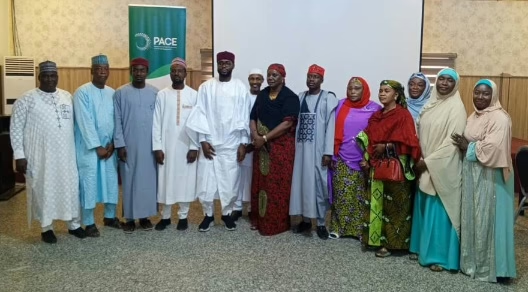
Speaking on Tuesday at a technical drafting workshop organized his ministry in partnership with the Partnership for Agile Governance and Climate Engagement (PACE), a UK Foreign, Commonwealth and Development Office (FCDO)-funded program, on the Kano State Climate Change Bill, the Commissioner for Environment and Climate Change, Dr. Dahiru Muhammad Hashim, described the bill as a critical step in moving climate action from policy intention to legal obligation.
He commended facilitators, technical experts, representatives of Ministries, Departments and Agencies (MDAs), and development partners for the depth and seriousness of deliberations so far, noting that the session came at a crucial stage in the drafting process.
The Commissioner said Kano State was already feeling the effects of climate change through flooding, land degradation, mounting waste challenges, urban heat, and increasing pressure on infrastructure and livelihoods.
According to him, these challenges require more than isolated projects or policies, but a clear legal framework that defines responsibilities, ensures continuity, and promotes accountability over time.
The Commissioner recalled that in January, the state approved the Kano State Climate Change Policy, which outlines its vision and strategic priorities.
An implementation plan has since been developed to guide coordinated action across MDAs, local governments, and non-state actors.
Dr. Hashim explained that the proposed bill is designed to legally anchor those commitments.
“A climate policy guides, but a climate law obligates,” Dr. Hashim said, stressing that the bill would institutionalise climate action and ensure long-term compliance rather than short-term interventions.
He emphasised the importance of broad stakeholder engagement, noting that climate change affects key sectors such as agriculture, transport, waste management, energy, land use, finance, and social inclusion.
He said laws that fail to reflect sectoral realities risk being ineffective, adding that the inclusive drafting process was aimed at producing a practical and enforceable law.
Dr. Hashim also highlighted Kano State’s recent progress in climate governance, supported by reforms, partnerships, and tools provided through the Partnership for Agile Governance and Climate Engagement (PACE).
He said the state’s improving performance in subnational climate governance assessments reflects its growing readiness for effective coordination, access to climate finance, and engagement with national and international partners.
However, he noted that sustaining these gains would require strong institutions backed by clear legislation, describing the Climate Change Bill as a foundational instrument for that purpose.
The Commissioner urged participants to focus on clarity of sectoral responsibilities, institutional coherence, and robust enforcement and accountability mechanisms as drafting continues.
He expressed confidence that the final bill would be robust, practical, and aligned with Kano State’s development priorities, making it suitable for consideration by the Executive Council and the State House of Assembly.
The Commissioner appreciated the technical support of PACE and thanked stakeholders for their commitment to developing a climate change law that would serve Kano State both now and in the future.