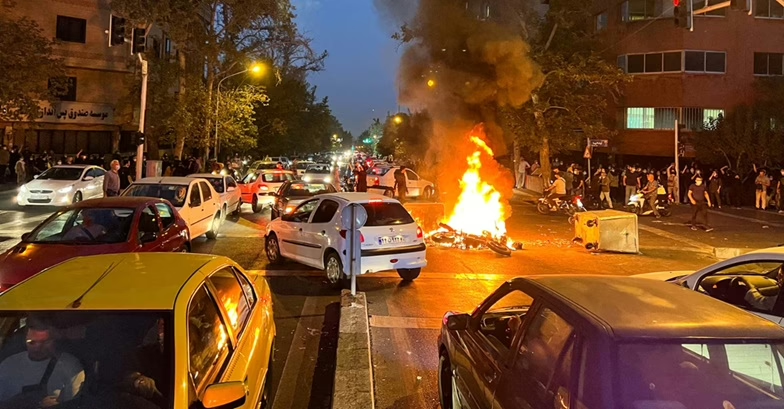
Large-scale anti-regime protests swept across Iran on Wednesday in what rights groups described as the biggest day of unrest so far.
Security forces fired tear gas at demonstrators in Tehran’s Grand Bazaar as parallel clashes and strikes erupted nationwide, including in the holy city of Mashhad. More protests are planned for Thursday, signaling that the unrest shows no sign of easing.
The demonstrations, now in their 11th day, have spread to scores of cities and key commercial centers, underscoring the breadth of the challenge facing the authorities.
The Human Rights Activists News Agency (HRANA) say the unrest has turned deadly, with nearly 40 people killed since the protests began.
Newsweek has contacted Iran’s Foreign Ministry for comment via email.
Why It Matters
The breadth of the unrest and the speed with which it has spread across Iran underscore a level of public anger that goes beyond isolated economic protests, pointing instead to deeper frustration with governance, corruption and living conditions.
The involvement of bazaar merchants, a powerful social and economic force with a historic role in past revolutions, suggests the movement is no longer confined to the streets, but is beginning to disrupt the country’s economic core.
The growing death toll and reports of mass arrests have also drawn sharp international attention, increasing pressure on Tehran at a sensitive moment.
President Donald Trump has warned that Iran would be “hit very hard” by the United States if more protesters are killed during demonstrations, highlighting the risk that a domestic crisis could escalate into broader diplomatic confrontation as the crackdown intensifies.
What To Know
The unrest began after Iran’s currency, the rial, plunged in value, driving inflation higher and sharply increasing the cost of living.
What started as localized demonstrations in Tehran’s Grand Bazaar has escalated into a nationwide movement, now entering its 11th consecutive day.
HRANA has reported at least 36 people have been killed since December 28, including 34 protesters and two members of the security forces.
Four of those killed were under 18. Dozens more demonstrators have been injured, many after being struck by pellets or plastic bullets fired by security units.
Protests have been documented in as many as 285 locations across 92 cities in 27 provinces, with more than 2,000 people arrested as authorities attempt to suppress the unrest.
Security forces have deployed tear gas, conducted direct assaults on demonstrators, and reportedly targeted hospitals treating the wounded.
The unrest has increasingly focused on economic and political centers. Demonstrators have chanted against senior leaders, attacked symbols of state authority, and organized strikes in major markets, including Tehran’s Grand Bazaar and commercial hubs in Mashhad.
The combination of street protests and economic dissent underscores the depth of public anger, reaching both major cities and smaller towns, and signals the broadest wave of unrest Iran has seen since the 2022—23 protests.
Those protests followed the death in police custody of 22-year-old Mahsa Amini, which ignited nationwide outrage over government repression and women’s rights.
U.S. Response
Washington has strongly condemned Iran’s crackdown on protesters, particularly attacks on hospitals. The State Department’s Persian-language account on X denounced strikes on facilities in Ilam and Tehran, calling the targeting of medical centers “savagery” and a violation of basic human dignity.
The Republican-led U.S. House Foreign Affairs Committee highlighted that protesters are “rising up and claiming entire cities,” warning that the Iranian regime’s “grip is unraveling,” while sharing footage of large crowds.
Senator Lindsey Graham criticized the violent repression and emphasized that President Donald Trump’s warnings should be taken seriously. Last week, Trump posted that the U.S. was “locked and loaded and ready to go.”
Anti-regime protestors are rising up and claiming entire cities. Iranians have had enough of the tyrannical Ayatollah and his murderous mullahs.
The Iranian regime’s grip is unraveling. pic.twitter.com/ghWY1wCigk
— House Foreign Affairs Committee Majority (@HouseForeignGOP) January 6, 2026
Cash Payment
In response to the unrest, the Iranian government this week, announced plans to provide a monthly payment to each citizen of roughly $7.
Government spokesperson Fatima Mahajerani said the measure is intended to “preserve families’ purchasing power, curb inflation, and ensure food security.”
Most Iranians, however, face basic monthly expenses exceeding $200, highlighting the limited scope of the payment amid widespread economic hardship.
What Happens Next
In the coming days, Iran faces a tense and unpredictable path as protests show no signs of easing. Several opposition parties have called for a general strike on Thursday, signaling continued nationwide mobilization.
Security forces are expected to intensify crackdowns, particularly in major cities and commercial hubs, increasing the risk of further casualties.
Economically, limited measures such as the government’s monthly payment are unlikely to reduce public frustration, suggesting the unrest could expand both geographically and across social sectors in the week ahead.
(Newsweek)