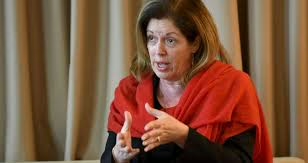
The former United Nations Special Adviser on Libya, Stephanie Williams, has revealed fresh details surrounding the collapse of Libya’s planned 2021 presidential elections, preparations for a confidential meeting in Abu Dhabi, and allegations of bribery linked to the Libyan Political Dialogue Forum.
Speaking in a podcast interview with Libya Al-Ahrar, Williams argued that the failure of the December 2021 vote was rooted in flaws within the electoral legislation rather than shortcomings in the UN-backed roadmap.
Electoral laws blamed for collapse
Williams said the election laws “opened the door” to the candidacy of approximately 99 individuals for the presidency, including Saif al-Islam Gaddafi, Khalifa Haftar, and Abdulhamid Dbeibah.
“The electoral laws are what led to the failure of the process, not the roadmap,” she said, citing the lack of domestic consensus around several controversial candidates and what she described as broadly framed legal provisions.
Williams noted that Saif al-Islam remains wanted by the International Criminal Court on charges of war crimes.
She also criticised Mr Dbeibah, stating that he had pledged, both verbally and in writing, before the Libyan Political Dialogue Forum, not to run for president.
“He lied. He did lie,” she said, adding that a substantial portion of the country rejected Mr Haftar following his 2019 military offensive on Tripoli.
According to Williams, the period preceding the political dialogue process included attempts to stabilise the political groundwork before external interference later intensified.
Abu Dhabi meeting described as “political theatre”
Williams also disclosed details of preparations for a confidential meeting in Abu Dhabi between former Prime Minister Fayez al-Sarraj and Field Marshal Haftar.
She described a series of meetings that began in 2017 and culminated in discussions linked to Abu Dhabi in February 2019 as a form of “political theatre”.
During the Palermo Conference in November 2018, both Sarraj and Haftar reportedly asked the then-UN envoy to Libya, Ghassan Salamé, to arrange an undeclared meeting between them.
“We told them we did not want a meeting that would be futile,” Williams said, explaining that efforts were subsequently made to align on key principles relating to the structure of government and the proposed National Security Council.
Three sessions were held in Tunis in January 2018, she added, before logistical considerations led to plans for the two men to meet in the United Arab Emirates.
Sarraj was travelling for a family occasion, while Haftar was reportedly seeking medical treatment, making Abu Dhabi a practical meeting point.
Other proposed venues included locations inside Libya and the Italian island of Sardinia. However, the arrangements ultimately collapsed.
Bribery allegations and foreign interference
Turning to the Libyan Political Dialogue Forum, Williams said preparatory meetings began in Montreux, Switzerland, with participants insisting the forum remain strictly political in nature.
Representatives from various regions were nominated, she said, noting that former Interior Minister Fathi Bashagha had put forward two candidates from Misrata, including Abdulhamid Dbeibah.
Williams maintained that there was no evident foreign interference at the outset of the forum. She suggested such involvement became more pronounced during attempts to form a second government in 2021 and 2022.
Regarding allegations of bribery linked to the dialogue process, Williams said she had seen only media reports and had not been presented with direct evidence prior to leaving her UN post.
“I can say I was shocked,” she said. “The only thing I saw were press articles, because I had already left the United Nations at that time, I left at the end of the Geneva dialogue.”
A new envoy assumed responsibility without consulting her, she added.
“I saw nothing. I saw no evidence. But if this was something discovered by the Panel of Experts, then it should be published. Concealment is worse.”
Williams concluded that transparency remains essential if Libya is to restore public confidence in any future electoral or political process.
(Libyan Express)