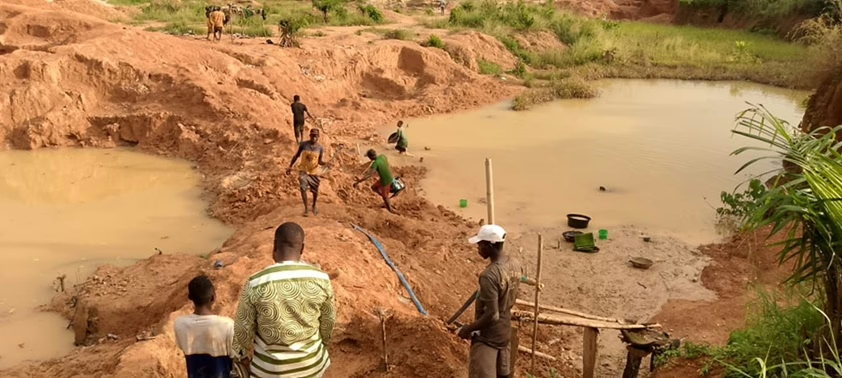
Fourteen-year-old Michael begins most mornings not in a classroom, but at an open gold mining site in Osun State.
He tells himself the long hours are temporary, that the money he earns will help him return to school after his parents can no longer pay his fees. But the reality is harsher.
In less than two weeks of mining, Michael has missed so many lessons that his teachers say he may not be able to catch up.
Each day he works to “save his education”, quietly pushing it further out of reach, trading textbooks for tools, and a future in school for one in the mines.
The story of Michael (not real name) mirrors that of hundreds of other children in the gold-rich communities of Iperindo, Ibala and Idooko in Ijesaland, where the promise of daily cash is quietly replacing the promise of classrooms and silently damaging children’s health.
Risking various health complications like mercury poisoning that damages their brains and kidneys, lead poisoning, and chronic silicosis from inhaling razor-sharp dust, these children are quietly sacrificing their bodies and future for a few grams of gold.
What began decades ago as artisanal mining for survival has evolved into a vast, chaotic ecosystem, one that now relies heavily on children aged 11 to 18.
Many of the children have abandoned school and their health in a desperate bid to support families struggling to feed themselves.
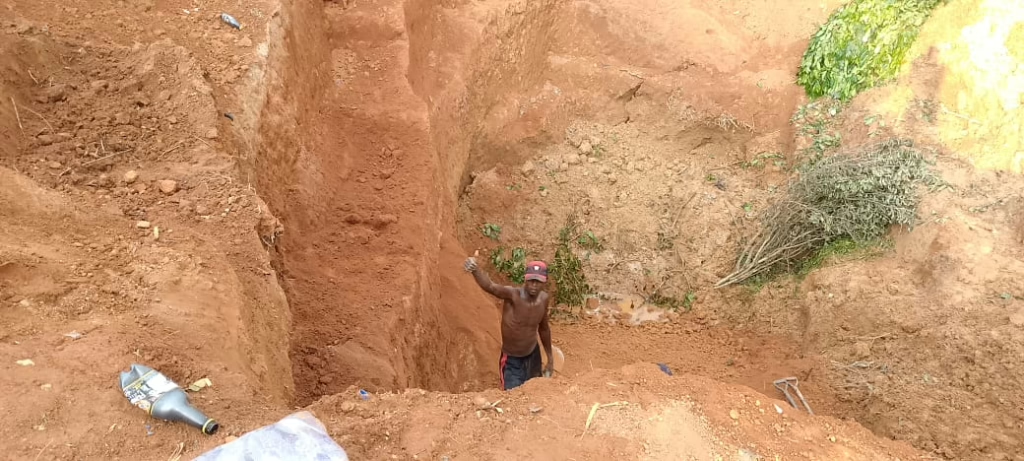
During several days of field investigation across these communities, which are now major informal gold-mining corridors in Southwestern Nigeria, scores of children were seen hauling sacks of ore, crushing rocks with oversized hammers.
Their lives echo a national crisis. According to the 2022 Nigeria Child Labour Survey Report, 39.2% of Nigerian children aged 5 to 17 standing over 26 million are trapped in child labour, with mining among the most dangerous forms.
Across Africa, Asia, and South America, tens of thousands of children work in small-scale gold mines, where daily survival is exchanged for lifelong health consequences.
In Osun State, this global challenge takes a distinct local shape in mining communities such as Iperindo, Itagunmodi, Araromi, Iponda, Ibala, and Idooko, which have become hubs where children mix mud, mercury, and sweat to extract gold that disappears into complex supply chains.
In these sites, the hazards are multiple and unforgiving. Underground tunnels collapse without warning. Dust thickens lungs.
Mercury vapour silently poisons bloodstreams. Many children interviewed described chronic headaches, chest tightness, persistent coughing, back pain, and skin infections that began shortly after they started mining.
They work with no gloves, no masks, no boots, nothing to protect their growing bodies from toxic exposure. “Since he started working at the mine, my head has hurt all the time. My chest feels tight, and I cough a lot.
We don’t have gloves, masks, or boots. We work like that, even when our bodies are hurting,” one of the children said.
The Nigeria Child Labour and Forced Labour Survey (NCFLS) paints a troubling national picture that aligns with the findings of this investigation. Of the 62.9 million Nigerian children aged 5 to 17, a significant majority live in rural communities like Ijesaland, where poverty intensifies child labour.
The survey categorises Nigerian children into groups: those in school only, those working only, those combining work with school, and those neither in school nor working.
Among children aged 15 to 17, the age group most involved in mining, 21.9% work exclusively, while another 45.3% both work and attend school, often at the cost of their health and sleep.
Nigeria’s Child Rights Act (2003) prohibits hazardous labour for children under 18. Yet, gold mining is one of the most hazardous occupations in existence, and remains an open secret in Osun’s artisanal sites. Laws exist on paper, but enforcement remains nearly nonexistent.
“We Had to Survive:” Children Speak from Inside Osun’s Gold Pits
“I had to survive,” says 15-year-old Joshua (not real name), his voice barely louder than the clang of metal on stone as he sits on a pile of crushed ore.
Joshua, who has been working with artisanal miners for over four years, says that mining is the only job he has ever known that provides enough money to support his family.
He knows the pits can collapse, the dust can choke him, and the mercury can slowly ruin his body, yet the fear of hunger outweighs every danger.
“There was no money. Sometimes I make up to N10,000 daily, and I use it to feed myself and sustain myself as there is nobody to cater for me,” he says.
Jacob, a 16-year-old junior secondary school student, believes he is saving enough money to improve himself in life.
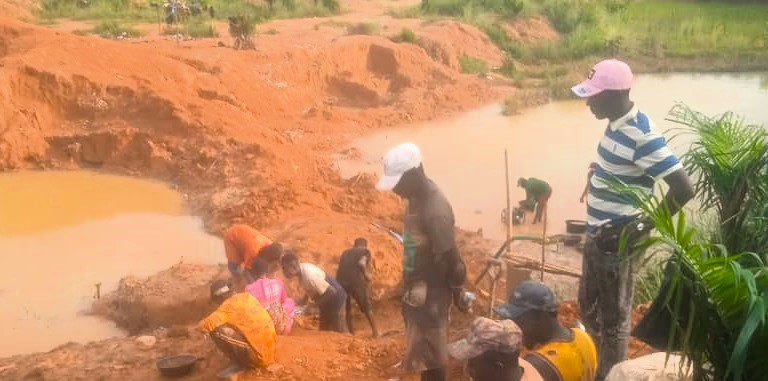
Although his parents are doing everything they can to keep him in school, they lack enough money to cover the fees, books, and uniforms; therefore, he now spends weekends at the mining site. It is a place he has been visiting for about five years.
“I am in school, in JSS 3, but my parents can’t give me all the things I need. When I need to do anything for myself, I usually come here to make some money to do the things,” he explains.
Bosun, who had previously suffered from pneumonia due to dust exposure at the mining site, said he would continue working despite the health risks he faces.
“I have been hustling here for a long time,” he says. “My parents cannot take care of me. I need money every day. I don’t want to steal. This work is hard, but I cannot leave it.”
The Walk of Shame: Parents Explain Why Their Children Now Mine Gold
Mothers and fathers who once carried their children to school now walk them in silence to the edge of a gold pit, an act that has become the norm, with nobody batting an eyelid at the child labour and the trading of the child’s future.
Some Community elders in Ibala explained that declining agricultural yields, unemployment, and the absence of government support have forced households to rely on whatever gold particles their children can gather.
The families of these children often feel trapped. Parents and guardians interviewed repeatedly echoed the same sentiment: mining is the only available means of survival.
In Ibala, a mother of four, popularly known as Iya Oko explained that her 13-year-old daughter mines part-time to buy school supplies and food.
“We know it is dangerous,” she admitted, “but hunger is more dangerous.”
An elderly miner in Idooko admitted that while the work is dangerous, “the children are faster and stronger than we are. They help us survive.”
That survival, however, is purchased at the price of their childhood as the children crush ore for hours using small metal hammers on slabs of rock, producing clouds of dust thick enough to coat eyelashes and nostrils.
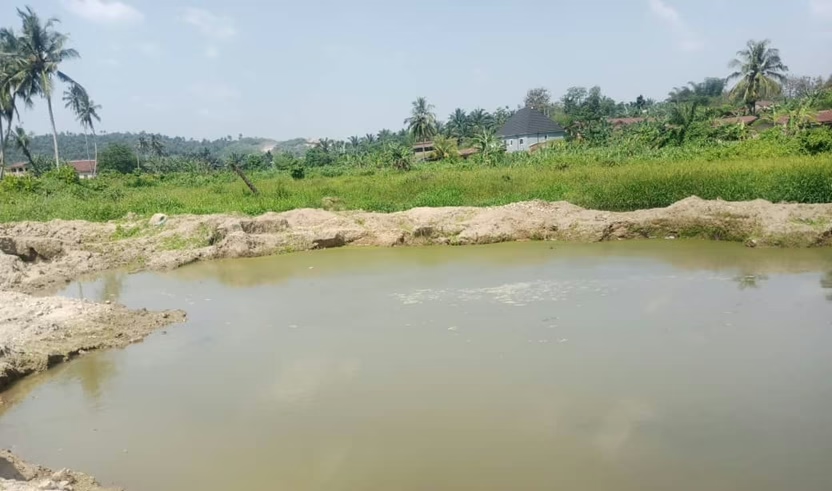
Several children stand knee-deep in murky waters, digging sand from riverbeds, unaware of the dangers of waterborne diseases.
Education, which should shield these children from generational poverty, has instead become one of the first casualties of their economic struggle. During visits to Ibala and Idooko, community members lamented that many children skip school for several days each week to mine.
The long distances to the nearest secondary schools, coupled with poor road networks, worsen the situation. Some families lack basic transportation, causing children to choose the mine over the classroom.
Meanwhile, government-owned schools that do exist operate without guidance counsellors, leaving children without emotional or academic support.
In some mining sites, primary school children keep their school uniforms in polyethene bags, changing into mining rags after school hours.
Teachers interviewed admitted their classrooms are half-empty during planting and mining seasons.
A teacher in a public secondary school in Iperindo, who spoke under anonymity, described her daily battle, noting that the total number of students in her classroom is 50 on the register, but hardly 25 come to school daily
“We are teaching ghosts. The children are physically here but mentally buried inside the mines.”
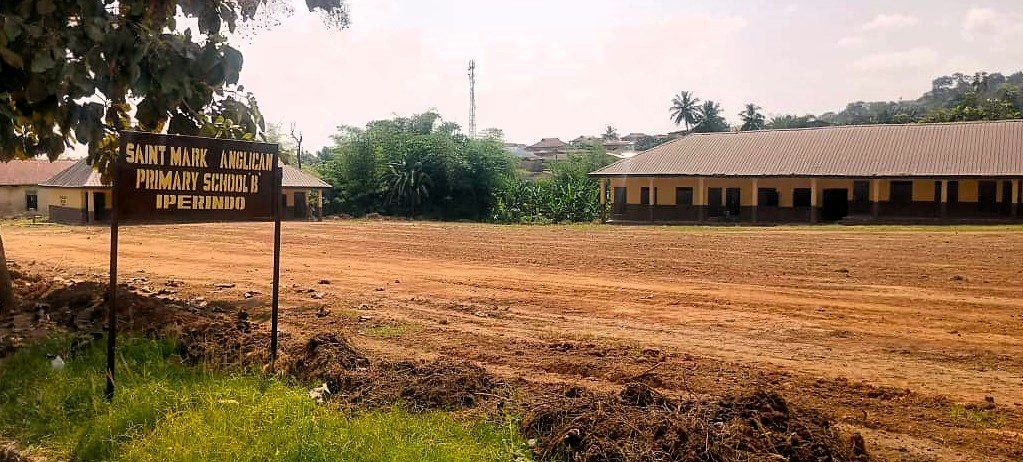
Health conditions in these gold-mining corridors are dire. Communities like Ibala, Iponda, Itagunmodi, and Idooko lack functional clinics, maternity centres, and emergency services. Children who fall ill after inhaling dust, chemicals, or smoke from ore-burning processes rely on improvised home remedies or herbal mixtures.
During the investigation, a 16-year-old miner exhibited scars on his hands from repeated exposure to mercury used during gold amalgamation.
Inhaling Danger: How Poverty Pushes Children into Dangerous Mines
Poverty has been identified as the major reason children abandon education to engage in childhood for shovels and pickaxes. Instead of sitting in classrooms, many are found deep in artisanal mining sites, breathing in heavy dust and toxic chemicals day after day.
“Many of the children lack parental care because their parents are not financially stable, hence the reason many of them work at mining sites,” explains Olori Iyabo Akintokun, coordinator of the International Labour Organisation’s (ILO) ACCEL Africa project in Idooka.
“What they don’t know is that though they are making money, they are affecting their future because they are not going to school, and medically, they are inhaling chemicals and heavy dust at the mining sites,” she warns.
The immediate cash may help families survive today. Still, the long-term cost is devastating: missed education, stunted growth, respiratory illnesses, and a future trapped in the same cycle of poverty.
To break this cycle, Akintokun and her team are stepping in with community sensitisation programs while calling on the government for stronger action.
“We have been engaging in sensitisation in some communities, and we are urging the government to provide totally free education and empower the children in vocational skills, as data revealed that 45% of the children in the lowest quintile are out of school and engage in child labour,” she said, quoting data from the ILO Nigeria Child Labour Survey of 2022.
“The government should also provide soft loans parents can use to start businesses because we found out that poverty is the major reason parents take their children to mining sites.”
Until sustainable solutions reach these families, more children will continue to inhale danger and watch their dreams disappear in clouds of dust.
“These Children Risk Kidney Failure and Lung Disease,” Warns Dr Adebola
Dr Adetoye Adedapo, an anaesthesiologist and former Chairperson of the Nigerian Medical Association, Osun State Chapter, has treated many miners and is deeply alarmed by the exposure of children to this highly hazardous work.
He said that, apart from exposing the children to kidney failure and lung diseases, they could also develop bad habits like smoking and taking hard drugs.
“These children are being exposed to mercury, lead, silica dust and cyanide on a daily basis,” he said.
“We are already seeing children with skin diseases and pneumonia, but there might be others with kidney failure, irreversible lung scarring, liver damage, and neurological disorders.”
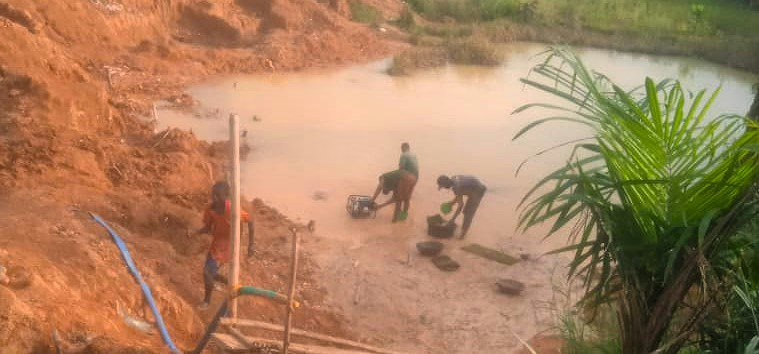
He called on the Osun State Government, the Federal Ministry of Mines and Steel Development, and the Ministry of Labour and Employment to immediately enforce the existing ban on illegal mining and strictly prohibit anyone under 18 from entering mining sites.
He further urged the creation of free screening and treatment programs for heavy-metal poisoning, deployment of mobile clinics and social workers to affected communities, and heavy fines or shutdowns for operators who employ children.
“Without these interventions, Osun risks losing an entire generation to wounds seen and unseen that will shape their futures forever,” Dr Adedapo said.
Osun State Intensifies Fight Against Child Labour
Against this troubling backdrop, government officials insist that progress is being made in curbing child labour in some mining communities in Osun State. Mr. Faloun Olagoke, Child Labour Desk Officer at the Federal Ministry of Labour and Employment, points to Ibala as an example where sustained intervention has reportedly led to improvements.
According to Olagoke, the state government officially prohibits child labour and has increased surveillance in mining communities identified as high risk.
He says authorities are intensifying community sensitisation efforts aimed at keeping children away from hazardous work and ensuring their return to school.
“We are partnering with the International Labour Organisation under the Accelerated Action towards the Elimination of Child Labour in Africa (ACCEL-Africa) project to eliminate child labour in Osun State,” Olagoke said.
He further claims that consistent monitoring and enforcement in Ibala have led to a significant decline in the number of out-of-school children.
However, these assurances stand in stark contrast to accounts from children currently working in nearby mining sites, raising questions about how widespread and sustainable the reported gains truly are.
Olagoke says the government’s response includes economic empowerment initiatives for families, training of community stakeholders, improved safety standards, and the strengthening of community-based monitoring mechanisms.
When asked whether these interventions specifically addressed the cases of children interviewed for this report, officials did not provide detailed examples or measurable outcomes linked to individual children or specific households.
Despite official claims of progress, the Child Labour Desk Officer admits that the ministry lacks the manpower and resources needed to routinely monitor remote mining sites.
Many affected communities, he says, still suffer from poor school facilities, long walking distances, and a lack of affordable transportation, conditions that continue to push children out of classrooms and into hazardous work.
For Michael the closest public school is several kilometres away. On most mornings, he chooses the mine instead, not because he prefers it, but because it is closer, cheaper, and puts food on the table. “If school was nearer, I would go,” he says quietly. “But the mine is here.”
Child-rights advocate says stories like Michael’s expose the gap between policy and reality. “You cannot claim progress while children are still digging for gold instead of sitting in classrooms,” he argues.
“Government intervention cannot stop at statements and pilot projects. With elections approaching, this is the time for leaders to show whether child protection is truly a priority or just a talking point.”
As Osun State heads toward another election cycle, the question remains unanswered: how many more children must trade their education for survival before enforcement moves beyond promises and into action?
This report was produced with support from the GNP Project