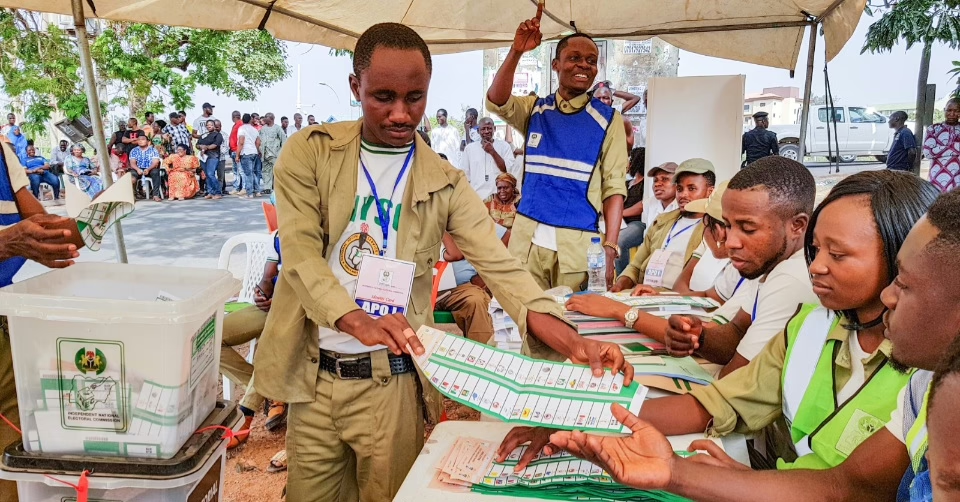
As voters in the six Area Councils in the Federal Capital Territory (FCT) head to the polls tomorrow, Grassroots Center for Rights & Civic Orientation (GRACO) calls for adequate measures to boost voter confidence and by extension turnout.
Given the quantum of public resources expended to organise the elections, robust turnout of voters should be one of the key indicators to measure if the elections are credible and participatory.
GRACO calls for impeccable Election Day logistics and strategic security deployment to ensure a seamless experience for voters.
According to a statement issued on Friday by GRACO’s Executive Director, Armsfree Ajanaku, the management of the entire electoral process should address historic factors that undermined participation in past elections.
“Drawing from GRACO’s recent research findings, we emphasise the urgent need to address systemic anomalies that deter citizens from exercising their fundamental right to vote,” the statement added.
Other parts of the statement read;
GRACO therefore calls for an inclusive electoral environment where every eligible voter can participate without fear or hindrance, ensuring that the voices of all eligible FCT voters shape the democratic process and the future of their communities.
We make no mistake about the fact that voter participation is the cornerstone of a vibrant democracy.
Yet, data from previous elections in the FCT reveals alarmingly low turnout. In the 2022 Area Council elections, turnout rates across the six councils averaged around 9%, ranging from a dismal 5.3% in Abuja Municipal Area Council (AMAC) to 18.08% in Abaji, far below national and global benchmarks.
This level of alienation of voters from the electoral process reflects deep-seated issues that erode public confidence and perpetuate cycles of exclusion. With 1,680,315 registered voters for the FCT 2026 elections across 2,822 polling units, the potential for robust participation exists.
However, this will not be achieved, if key issues that make voters stay away from the process are not decisively addressed.
Low turnout risks further marginalising vulnerable groups and weakening the legitimacy of elected officials.
Key among the challenges is the lack of trust in elections.
Many citizens view election outcomes as predetermined, and this notion is fuelled by past instances of manipulation, violence, and procedural delays.
Similarly, the use of state resources for campaigning and weak campaign finance monitoring frameworks take away every semblance of a democratic contest driven by the imperative of political accountability.
Apparently, the perception of pre-determined electoral contests discourages participation, particularly among youth who already feel disconnected from governance.
In Nigeria’s local governance context, voter apathy is exacerbated by bad governance, including high levels of corruption, unfulfilled political promises, and the failure of elected officials to deliver tangible benefits to communities.
Economic hardship, absence of basic amenities, unemployment and deteriorating social conditions, further reduce the incentive to vote, as citizens question whether their participation leads to real change.
Security concerns equally play a huge role, with threats of political thuggery and violence around polling units deterring voters, especially women and PWDs.
Electoral malpractices, including vote-buying, and the complicity of some security officials, reinforces this distrust.
Furthermore, persons with disabilities face unique obstacles that further entrench apathy.
Inaccessible polling stations lacking ramps, tactile ballots, or sign language interpreters exclude PWDs from the process, violating principles of inclusivity enshrined in national policies like the Discrimination Against Persons with Disabilities (Prohibition) Act. GRACO’s research data, mined from previous election cycles underscore how these challenges not only limit participation but also perpetuate feelings of marginalisation among various demographic.
Compounding these issues is the inadequate civic and voter education.
Women and youth often encounter cultural, economic, and informational barriers that hinder their involvement.
Many perceive local government officials as unresponsive, delivering little tangible benefit to communities, which diminishes the incentive to vote.
Politicians’ sporadic engagement limited to election seasons and their recourse to vote buying, fake news and disinformation further erodes trust.
Logistical challenges, including delays in election officials’ arrival, malfunctioning equipment like the Bi-Modal Voter Accreditation System (BVAS), long queues, and poor transportation in rural areas, add to voter frustration with the electoral process.
Despite the challenges, GRACO acknowledges the efforts of the Independent National Electoral Commission (INEC) in the FCT to address a number of these issues.
In the pre-election period, INEC FCT has engaged in far-reaching consultation with civil society in the areas of election risk mapping and management.
We also commend community-led initiatives in districts like Gwarimpa and Kubwa, with the objective of sensitising residents on the importance of voting. However, these steps must translate to robust turnout on Election Day.
We similarly call on the Election Management Body to prioritise transparent communication, including continuous dissemination of polling unit locations, procedures, and real-time updates via digital platforms and on community radio.
This will mitigate logistical frustrations and empower voters with accurate information.
Importantly, on Election Day, we hope to see polling stations that are fully accessible by enforcing disability-inclusive standards, such as ramps and priority queues.
Finally, GRACO encourages candidates to maintain decorum and avoid inflammatory rhetoric.
Political actors should refrain from spreading hate speech, misinformation and disinformation before, during and after the elections.
As the clock ticks down to voting day, GRACO urges all eligible FCT residents to demonstrate resilience by trooping out en masse to vote their candidates of their choice.
As we build up to the 2027 general elections, let this the FCT Area Council polls be a turning point, demonstrating that apathy can give way to active participation in the democratic process.