Omowumi Abraham
For over 10 years, residents of Ifelodun Community, in Oke-Odo, under the Ona-Ara Local Government Area of Oyo State, have lived in near isolation, cut off from neighbouring communities, basic services, and emergency care because of an abandoned bridge project they were initially forced to construct themselves.
What began as a community-driven effort to survive has become a painful symbol of government neglect, unfulfilled political promises, and systemic failure at the grassroots level.
A Bridge Built by the People, Not the Government
According to the chairman of the community, Mr. Mutiu Owotutu, the bridge project started more than a decade ago out of sheer necessity.
“We started this bridge over 10 years ago, building it little by little with our own resources. When we could no longer continue due to a lack of funds, we called for help. We wrote letters to the local government and went from office to office, but nothing came out of it,” he told this reporter in an interview during a visit to the community.
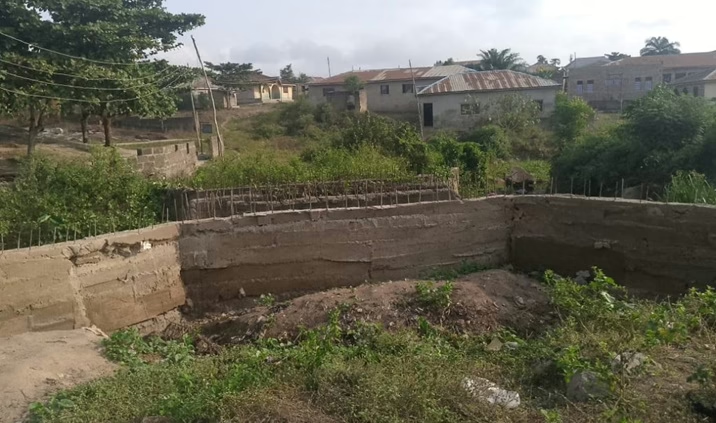
Without intervention from authorities, residents pooled their personal funds to construct the bridge. Over time, they have spent approximately N20 million, an enormous sum for a low-income community.
Yet despite three separate construction efforts, flooding has repeatedly destroyed the structure, compounding the community’s woes.
“The first bridge was swept away by rain. The second one, too. This is our third attempt,” Owotutu said.

Engineers sent by the government reportedly inspected the bridge and commended the quality of the work, noting that only proper covering and drainage were needed to make it functional.
Rainfall halts movements, and pregnant women risk complications
The consequences of the unfinished bridge are most severe during the rainy season. The canal overflows, completely surrounding the community and making movement in and out of it almost impossible.
“Whenever it rains, we cannot go out or come in. The river surrounds us,” the chairman explained.
One incident highlights the danger starkly. It was gathered that a pregnant woman went into labour at night and required urgent medical attention. With the community inaccessible, she could not be taken to a hospital.

“Thankfully, we had midwives among us who helped deliver the baby. If not, we might have lost the mother and child,” Owotutu said.
Residents say such emergencies are common. They expressed fear that sometimes, the outcome may be unfortunate.
Blocked access to education, trade, and health
The bridge crisis has crippled access to education. Children from Ifelodun cannot attend schools outside the community when it rains, and students from neighbouring areas are unable to reach schools in their localities.
The impact extends beyond Ona-Ara Local Government, spiraling towards Oluyole LGA, and affecting multiple settlements.
Healthcare access is dire. According to residents, there is no primary healthcare centre within the community.
“We have to leave the community to give birth or treat ourselves. Because the place is not accessible, government officials avoid us,” said Mrs. Dasola Amoo, a landlady.
Traders are unable to bring goods into the area. Tenants refuse to rent apartments, and houses are being abandoned.
“People are leaving. Homes are empty. Families are displaced. Even our children who go to school outside don’t want to come back,” Mrs. Amoo added.
₦15 Million Away from Relief
Community leaders estimate that about N15 million is required to complete the bridge, properly cover it, reinforce the sides, construct drainage, and fill the access points.
There are frustrations in getting help, according to Mr. Adegbite Kazeem, the Vice Chairman of the community.
“We have written letters to every local government chairman who has emerged. It has been more than a decade. We are running around because we need urgent help.”

Due to inaccessibility, residents now park their vehicles outside the community and trek in. When rain threatens, people call one another simply to confirm who is safe and who is stranded.
Ballot boxes manage to get to the community, but not the development. Residents accuse politicians of exploiting their suffering during election cycles.
“Every four years, they come to campaign here and promise to fix the bridge. After elections, we never hear from them again,” the Vice Chairman said.
Ironically, electoral officers still manage to access the community during elections.
“We fulfil our civic duties. If this bridge is fixed, our polling unit, which is currently far away, can even be moved closer,” Mrs. Amoo noted.
A Developing Community in Decline
An elderly community leader and resident described the long-term impact as devastating.
“This place was developing before. Now, people are running away. We don’t know what will happen in the coming rainy season.”
The elder made a direct appeal to Governor Seyi Makinde, urging state intervention before another year of destruction.
There Is No Money
The community’s Project Coordinator revealed that inspections had been carried out multiple times.
“When it rains, flooding covers everywhere. Nobody dares to pass. People here don’t have the money to relocate. They need immediate help.”
Despite repeated engagements, the local government reportedly responds with the same explanation: there is no money.
Survival Should Not Be a Privilege
The situation in Ifelodun–Oke-Odo raises urgent questions about governance, equity, and the right to basic infrastructure. Over 700 houses, seven communities, and four zones are affected by the lack of a functional bridge.
As another rainy season approaches, the people of Ifelodun are left with fear, frustration, and a single plea: that their lives matter enough for actions and not promises.
Engineer wades in
A civil engineer who has been involved in assessing the structure, Alawode Kazeem, noted that most of the heavy structural work had already been done.
“What is left is to cover the bridge and fill it properly. The three abutments and the wing walls have been completed. From this point, if we have about N8 million, the work can be finished,” he said.

Kazeem, who also owns a house in the Ifelodun–Oke-Odo community, maintained that the bridge’s foundation is solid and only requires finishing. His position appears to downplay the idea that funding constraints had stalled interventions.
For the residents, the N8 million to N15 million needed to fix the problem should not be an issue and only raises questions about priorities in an area where over 700 houses across seven communities remain cut off whenever it rains.
Like Ifelodun–Oke-Odo, like Osun Irewole
Another community within Ona-Ara Local Government, Osun Irewole, a few kilometres away from Ifelodun–Oke-Odo, is dealing with its own version of the crisis, this time driven by erosion and unchecked flooding.
Standing beside a damaged pathway, Taiwo Babatunji spoke with visible frustration over the havoc caused by flooding in the area.
“A flood has swept away houses here. People have been displaced. When it floods, we cannot cross to the other side,” he said.
According to him, residents have repeatedly resorted to self-help, but to no avail.
“Men, women, young and old, we carry cutlasses and hoes to create paths ourselves. We have written to the Ona-Ara Local Government, to the Oyo State Government, and even to the Federal Government, but nothing has happened.”
He recalled a visit by some government officials a few months ago.
“They came to inspect and told us they would return. Since then, we have not seen them,” he said with a hopeless gesture.
For many residents, the rainy season now brings anxiety rather than relief.
“Sometimes, we pray that rain should not fall. Look at that school. Before, it had many students, but now parents don’t want to bring their children here,” Babatunji added.
The community has contributed money several times to buy materials for temporary fixes. Each effort, they said, ended the same way.
“After fixing it in our little way, the flood sweeps everything away. We are tired.”
Fears Over Road Expansion
Residents are also worried about the impact of the ongoing Akran Road construction project, which stretches from Olorunsogo to Akran.
The Chairman of Osun-Irewole community, Alhaji Mudashiru Rahman, believes the expansion could worsen flooding in their community.

“The road is being expanded to four lanes, with drainage, and that canal that is more than six feet deep. Whenever it rains, all that water will come here. The flooding will multiply,” he said.
He explained that they had met with the local government chairman. “He told us there is little he can do for now. But nothing has been done.”
Rahman noted that while a previous administration built a security post in the area, their main concern, which is the canal and erosion, remains unresolved.
Community Efforts Washed Away
Residents say they have exhausted both their strength and finances.
Owolabi Fatai, one of the landlords, described how they repaired the damaged sections of the road by pooling their money among themselves.
“From that point down to here, we fixed it ourselves. But we cannot continue because we don’t have funds.”
For Mrs. Odutolu Bukola, daily life during rainfall is unbearable.
“Whenever it rains, water enters our homes. We cannot go out until the rain stops. The whole place becomes inaccessible.”
In one instance, the community reportedly raised funds to purchase 2,800 blocks to reinforce a failing canal.
“I supervised the work myself. Two hours after we finished, rain fell, and flood carried everything away,” the chief imam of the community, Alhaji Animashaun, recounted.
It was gathered that the residents later invited local government representatives and engineers handling the nearby road construction to assess the damage. Meetings were held, but nothing changed.
Residents also pointed to a community well that once served as their primary water source, which erosion has now made unsafe to access.
“We cannot even fetch water from our own well anymore. We now go to another community to fetch or buy water. That is how we survive.”
A Long Wait
Across both communities, frustrations echo: letters have been written, inspections conducted, and promises made, but silence persists.
What stands out is not only the flooding, but the pattern: residents build, floods destroy, officials visit, and nothing happens.
As the rainy season draws nearer, families are left to weigh their options: stay and hope, or abandon homes they built with years of savings.
For many here, the issue is simple: they are not asking for luxury. They are asking for access to roads, schools, hospitals, water, and safety.
And as one elderly resident quietly put it during the visit: “We are human beings too.”
LG’s Financial Autonomy Raises Fresh Questions
Not long ago, there was a major development in Nigeria’s local government system. After a Supreme Court ruling granted financial autonomy to local councils, allocations from the Federation Account Allocation Committee are expected to go directly to local governments starting in 2025.
The decision was welcomed in many quarters. It was seen as a way to reduce state interference and make councils more accountable for how money meant for grassroots development is spent.
In practical terms, it means councils like Ona-Ara Local Government in Oyo State now receive their allocations directly.
Data published by TheCableIndex shows that Oyo State’s local government areas received a total net allocation of N18.34 billion for November 2025.
Ona-Ara Local Government ranked seventh-highest recipient, with N636.53 million allocated that month.
Funds like these are meant to cover basic responsibilities at the local level, such as road maintenance, primary healthcare, basic education, sanitation, infrastructure, and community development projects.
But in communities like Ifelodun–Oke-Odo and others within Ona-Ara, residents say they cannot feel the impact.
For them, the issue is no longer just about promises. With direct allocations now in place, they believe there should be clearer results on the ground.
“When they say there is no money, we don’t understand,” one resident said quietly during this investigation. “If they are receiving allocations directly now, what is happening to them?”
It is a question that lingers across flooded roads, unfinished bridges, and eroded pathways, a question residents say deserves an answer, especially as another rainy season approaches.
Official Reaction
When contacted, the Chairman of the Ona-Ara local government, Hon. Kolapo Temitope Glorious, dismissed claims of neglect and suggested the process was simply ongoing.

“There is no problem. If they have written letters, it is not their turn yet. They have to wait. We received about 30 letters concerning bridges.
“We completed 7 bridges last year, and another 10 have been included in the 2026 budget. I don’t know whether the said community is among them.”
The response reflects a structured approach to project selection, according to the council. However, it offers little immediate relief to residents who say they have been waiting for more than a decade.
For the people of Ifelodun– Oke-Odo, the issue is not whether other bridges have been completed elsewhere. It is whether their long-standing appeal, backed by repeated letters, inspections, and personal financial contributions, will move from a file on a desk to actual construction on the ground.
As rainfall patterns grow heavier and more unpredictable, “waiting for their turn” remains a phrase that residents say they can hardly afford.
This report was support by Civic Media Lab