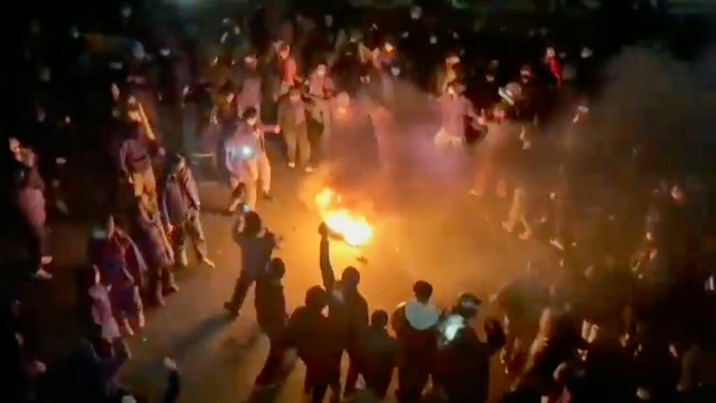
Fears are growing that the number of protesters killed by Iranian security forces now reaches into the thousands.
Despite an internet blackout, cell phone footage has emerged of truck-mounted machine guns strafing residential streets, hospitals swamped by shooting victims, and a morgue overwhelmed by hundreds of bodies after only the first night of assaults.
To account for what it called a “significant” death toll, the Islamic Revolutionary Guard Corps on Sunday raised the specter of ISIS, claiming in a statement that slain protesters were terrorists hired by Israel and the U.S. Two days earlier, a Guard official on state-controlled television had warned that anyone venturing into the street should be prepared to “take a bullet.”
No precise death toll can be ascertained. Tallies offered by respected human rights groups have climbed into the hundreds, but those organizations count only bodies that have been identified, painstaking work made difficult by a communications blackout that extends to cell phones and even land lines.
However, starting with reports from a handful of Tehran hospitals, an informal, expatriate group of academics and professionals calculated that protester deaths could have reached 6,000 through Saturday.
The calculation does not include bodies carried by authorities not to hospitals but directly to morgues—such as the hundreds lain on the floors and parking lot of the Kahrizak Forensic Center, outside the capital. According to a social media post, the scene shows only bodies killed on Thursday night.
The scale of the killing appeared to dwarf anything previously seen on the streets of Iran. In one city in Isfahan province, Nafjabad, the death toll was 35 for Thursday night alone. And the protests have reached all 31 provinces of Iran, a nation of 90 million people with 100 cities with a population above 100,000.
“I’m in Shiraz,” a protester told TIME in the wee hours of Sunday from the city of 1.7 million in the country’s southwest. Asking to go by “Lewis” for his own protection, he spoke via Google Meet on Starlink, the satellite internet network that is illegal in Iran for its ability to defy shutdowns.
Ahmad Ahmadian, a U.S.-based activist involved in smuggling the dishes into Iran, said at least 50,000 Starlink uplinks are there, though many may not be operating because of subscription fees. (Unlike in Ukraine and Venezuela, owner Elon Musk has not made Starlink free in Iran.)
The protests began in Tehran’s central bazaar on Dec. 28, after the collapse of the national currency sent the economy into freefall. But in Shiraz people went into the streets a week later, Lewis said, prompted by a call from Reza Pahlavi, the U.S.-based son of Iran’s former shah, or king. They were unlike previous demonstrations.
“It’s 100 percent different,” Lewis said. Besides drawing a much larger crowd, “the protesters this time have been much more organized and much more persistent.”
He added: “The police attacks are much, much more violent.”
Huge crowds turned up on Thursday night at the hour specified by Pahlavi and other opposition groups, chanting “Death to the dictator.” But on Friday, he said, the turnout in Shiraz was inhibited by aggressive security forces, and by Saturday only young men aged 15 to 25 ventured out to confront them, at times violently.
A Shiraz hospital told journalist Solmaz Eikdar of the Iran Wire news site that it was too overwhelmed by gunshot patients to admit any other kind of patient and that it was doing triage to treat those thought likeliest to survive.
In Rasht, on the coast of the Caspian Sea, residents were ordered to remain indoors under what amounts to martial law, Eikdar told TIME. She said her reporting from hospitals in that city, in Tehran, and in Shiraz confirmed at least 1,000 deaths.
The academics’ calculation began with the informal survey done by a Tehran physician quoted by TIME after phoning six hospitals on Friday to asking how many dead protesters each had.
The numbers—Milad (70); Imam Hossein (70); Ibn Sina (23); Labbafi Nejad (7); Fayaz Bakhsh (15); Shahriar (32)—totaled 217 deaths for just a single night. With a BBC report of a hospital in east Tehran reporting 40 dead, the group opted to use 30 as an average.
Of Tehran’s total universe of 118 hospitals, only 63 are either public or military. To be conservative, the researchers told TIME, they assumed only half of those received bodies, bringing the total estimate of protester deaths in Tehran to 900 for the night of Thursday, January 8, when the internet was first shut down. They added another 900 on Friday, when security had grown more violent, and trimmed it to 400 for Saturday’s smaller protests.
They then added 1,000 deaths for adjoining Alborz province, noting the intensity in the streets and its history from the 2022 hijab protests.
That brought the estimate to 3,200 deaths for those two provinces over three nights. They used the same approach for other cities, large and small, tweaking for ethnic and historic factors.
Then they halved their total, settling on 6,178 deaths over the three days, which witnesses say grew steadily more violent.
On Friday night, security forces were firing freely in the Nazemabad neighborhood of Tehran, a resident said. “There’s blood everywhere, on the walls, on the streets,” he said. “It’s catastrophic. They killed all they could.”
Some remained defiant. “There’s no doubt people want to get rid of the present system and replace it with something better,” said Lewis, in Shriaz. “And that’s why they’re getting themselves shot and killed.”
But the Iranian regime has a long and remorseless record, not only killing but maiming, notably with pellet blasts aimed into the eyes.
“It’s not so busy tonight,” a resident of the Niavaran neighborhood in northeast Terhan reported on Sunday.
“With this level of killings we’ve seen, everyone says I’ve lost a cousin, or a friend, or knows someone killed, and add to that so many people blinded. In Farabi Hospital they had to empty so, so many eye sockets.”
(TIME)