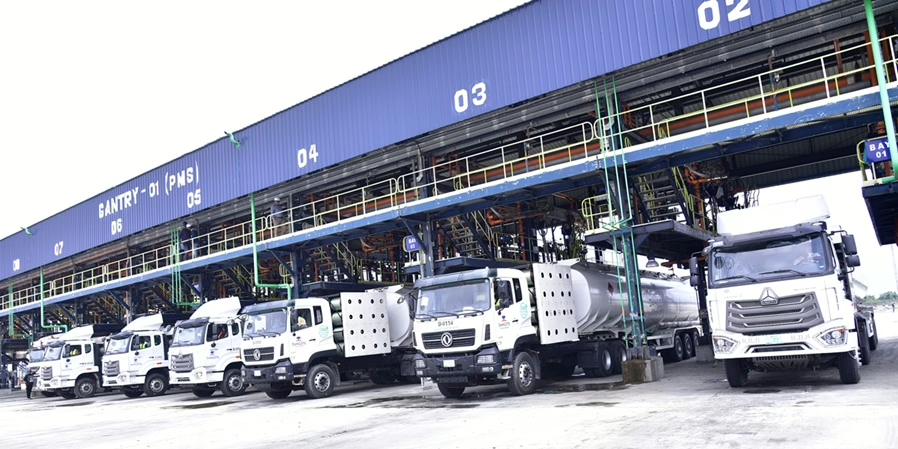
The Managing Director of Dangote Petroleum Refinery, David Bird, has reassured Nigerians that the refinery will continue to meet the nation’s fuel needs despite ongoing disruptions in the global oil and gas market.
He noted that while fuel import‑dependent countries are already experiencing panic buying and rationing, Nigeria will not face such challenges again as the refinery is committed to ensuring petrol availability across the country.
Speaking during a media chat, Bird said the refinery remains steadfast in supplying uninterrupted fuel to the Nigerian market even as geopolitical tensions in the Middle East drive sharp increases in crude oil prices, freight rates, and insurance costs.
According to him, the global oil market has seen an extraordinary surge within a short time.
“Just a week ago, oil was trading in the mid‑$60 range, and it has now climbed to nearly $120 per barrel,” he said, adding that the shock has affected every segment of the world’s energy supply chain.
Bird explained that, like all players in the global refining industry, Dangote Refinery is exposed to fluctuations in crude prices, freight charges, and insurance premiums.
However, he stressed that Nigeria now enjoys a critical advantage: supply security made possible by domestic refining capacity.
“What would be worse than $120 oil is no oil,” he stated, pointing out that some countries are already implementing rationing because they rely completely on imports.
He added that several nations with significant refining capacity have begun restricting fuel exports to safeguard local supply amid the ongoing global supply shock.
Bird emphasized that as long as the refinery continues to receive Nigerian crude through the Federal Government and the Nigerian National Petroleum Company Limited (NNPCL), it will sustain its supply to the domestic market.
“With government support and steady access to domestic crude, Dangote Refinery will continue to meet all of Nigeria’s refined fuel requirements,” he assured.
He revealed that the refinery is running at its full nameplate capacity of about 650,000 barrels per day—making it one of the world’s largest single‑train refineries.
The facility can produce between 50 million and 55 million litres of petrol daily, with the ability to increase output through blending if needed.
Nigeria’s daily petrol consumption is estimated at 35 million litres, Bird noted, underscoring that the refinery has more than enough capacity to meet national demand.
He further stated that the refinery is prioritising supply to the Nigerian market to guarantee what he described as “fuel abundance.”
“We will ensure that Nigeria enjoys fuel abundance, not fuel scarcity,” Bird affirmed.
However, he cautioned that pricing will still be influenced by global market conditions, as crude used by the refinery is purchased at international benchmark rates even under the crude‑for‑naira arrangement.
“Pricing is determined largely by global commodity markets,” he explained, adding that decisions about fuel price interventions rest with the government.
Bird concluded by noting that the refinery, which commenced sustained operations in early 2024, has significantly improved performance following maintenance and optimisation activities carried out earlier in the year.