For the thousands of frustrated travelers facing delayed and cancelled flights between Taiwan and its outlying Matsu Islands and Kinmen, there may have been a sense of déjà vu.
Last week’s multi-domain Justice Mission 2025 exercises were not the first occasion on which China’s large-scale military drills have disrupted civilian air routes in the region.
Yet the increasingly routine character of such exercises should not obscure their significance, nor how they are challenging long-standing cross-strait arrangements.
Beijing is, once again, testing a core element of the status quo that has underpinned a fragile peace across the Taiwan Strait for decades. This time, the focus is Taiwan’s contiguous zone, the 12-nautical-mile buffer surrounding its territorial waters.
The steady normalization of People’s Liberation Army (PLA) military activity within this space marks a subtle but consequential shift, one that lowers thresholds, increases the risk of miscalculation, and sets a potentially destabilizing precedent for future Chinese military operations.
After several months in which China’s large-scale military exercises appeared to be on hiatus, the closing days of 2025 saw their return.
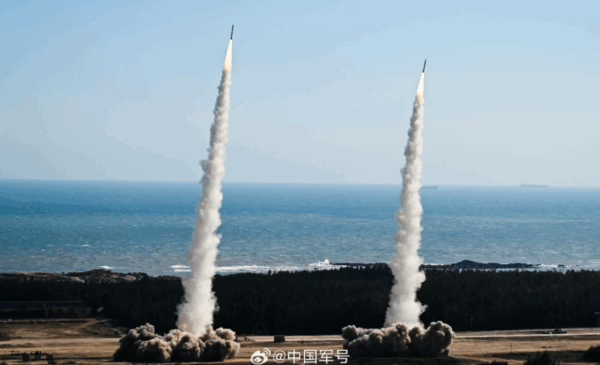
The December 29–30 Justice Mission 2025 drills brought together the PLA Navy, Air Force, Rocket Force, and other branches to rehearse a full maritime blockade of Taiwan, establishing air and sea control, targeting key ports, and deterring external forces from entering the island chain.
The exercise covered a larger area than any of the six major war games conducted since August 2022, when then U.S. House Speaker Nancy Pelosi visited Taiwan, and involved more than 130 aircraft sorties into Taiwan’s air defense identification zone, alongside 14 warships and at least 15 coast guard and other official vessels.
Lost amid the unprecedented scale of the Justice Mission exercises is a more consequential development: their increasing focus on the contiguous zone surrounding Taiwan’s main island.
Like other coastal states, Taiwan defines its territorial waters as extending 12 nautical miles from its baseline, beyond which lies a further 12 nautical miles of contiguous zone.
This area functions as a critical buffer, allowing authorities to address potential infringements before they reach sovereign waters or airspace.
In the Taiwan context, it has also helped distinguish between routine, if coercive, Chinese military activity and actions that more clearly signal an attempt to infringe upon Taiwan’s territorial sovereignty.
The Justice Mission exercises marked the first instance in which Chinese military and coast guard vessels entered Taiwan’s contiguous zone in significant numbers.
According to Taiwan’s Ministry of National Defense, 11 PLAN vessels crossed into the zone, alongside eight China Coast Guard and other official vessels. One Chinese destroyer, the Urumqi, reportedly withdrew only after a Taiwanese naval vessel applied a radar lock, a move that signals imminent capability to fire on the target.
In addition, 27 missiles were fired in or around the contiguous zone, although their precise impact locations have not been publicly disclosed.
The mass encroachment into Taiwan’s contiguous zone during the Justice Mission exercises follows several years in which China has steadily increased its attempts to challenge, and eventually cross, this boundary.
While never formally acknowledged by Beijing, the zone was largely respected for decades, with Chinese naval and coast guard vessels generally avoiding it.
That pattern began to shift in the early 2020s, most notably with a sharp increase in the activity of quasi-military maritime research vessels operating near the zone in 2023.
During exercises in April that year, dozens of Chinese and Taiwanese vessels engaged in standoffs along the edge of the contiguous zone in the Taiwan Strait, including a brief incursion by a Type 052D destroyer.
Two years later, the Strait Thunder exercise in 2025 saw a China Coast Guard vessel also enter the zone, reportedly reaching within 20 nautical miles of Taiwan’s main island.
While the distinction may appear technical, China’s efforts to erode the significance of Taiwan’s contiguous zone should be a cause for concern well beyond the Taiwan Strait.
Taipei has made clear that any intrusion into its territorial airspace would be treated as a “first strike,” reserving the right to respond with force.
No equivalent red line has been articulated for the contiguous zone, which has instead functioned as a critical final buffer to manage risk and prevent escalation.
If that buffer is gradually erased, the dangers multiply. Military drills conducted closer to Taiwan’s sovereign waters may be interpreted as actual attacks, thereby heightening the risk of miscalculation and unintended escalation.
Alternatively, actual attacks might be initially misinterpreted as drills, reducing Taiwan’s response time and weakening its response.
Either way, sustained activities in the contiguous zone push ever closer to Taiwan’s red lines, increasing the chances of provoking a military response.
Despite the significance of these developments, Taiwan’s partners have so far appeared slow to acknowledge how incursions into the contiguous zone make these drills qualitatively different from earlier exercises.
U.S. President Donald Trump, for example, said that “nothing worries me” about the drills, noting that China had been conducting naval exercises in the area “for 20 years.”
Statements from other G-7 partners, including Australia, Canada, the European Union, the United Kingdom, and Japan, largely reiterated familiar calls for restraint and the peaceful resolution of disputes, without addressing the escalated risks posed by the normalization of activity within Taiwan’s contiguous zone.
This points to a broader weakness in how the G-7 and other partners approach cross-strait stability. While officials routinely warn against any “unilateral change to the status quo,” far less effort has gone into defining what that status quo actually consists of in practice.
That ambiguity has already allowed Beijing to all but nullify the median line in the Taiwan Strait as a meaningful constraint on military behavior.
The latest exercises suggest a similar effort may now be underway with respect to Taiwan’s contiguous zone, despite the heightened risks involved.
Unless the United States and other governments begin to address this issue more explicitly, there is little incentive for Beijing to reconsider its approach.
(The Diplomat)