China’s climate policy is undergoing a subtle but consequential shift, one that will be confirmed in the coming days, when Beijing unveils its 15th Five-Year Plan at the annual meeting of the national legislature.
For the past decade, China framed its climate strategy around emissions control. President Xi Jinping made headlines in 2020 by pledging to peak carbon emissions before 2030 and achieve carbon neutrality by 2060. These “dual carbon” goals remain in place, but his ambitions have plateaued.
Today, Beijing’s emphasis is less on near-term emissions cuts and more on building global dominance in clean technology and green industry, with important implications for decarbonization, diplomacy and business. That is the finding of a new report I co-authored with Guoguang Wu for the Asia Society Policy
This is not a retreat from climate action so much as a reordering of priorities. China’s approach will still deliver emissions reductions, but more gradually and indirectly than climate advocates would prefer or UN frameworks envision.
China’s latest international commitment, announced last September, targets only a 7–10 percent reduction in greenhouse gas emissions from peak levels by 2035, a trajectory consistent with roughly 3 degrees centigrade of global warming, far above the Paris Agreement’s 1.5C goal.
The current Five-Year Plan set a binding target to reduce carbon intensity by 18 percent between 2021 and 2025. Official data indicate that China will fall well short of this mark. In both 2024 and 2025, Beijing declined to even set an annual carbon-intensity target.
Several high-level climate leading groups that coordinated emissions policy earlier in Xi’s tenure have not convened for years. Central environmental inspections have moved away from carbon outcomes and back toward conventional pollution control.
Recent top-level policy documents place heavy emphasis on green energy, green technology and green trade. The forthcoming Five-Year Plan is expected to reinforce this tilt by stressing industrial upgrading over tighter near-term emissions constraints.
Chinese leaders continue to present themselves as champions of international climate cooperation. But their advocacy now increasingly zeroes in on opposing “green trade barriers,” such as carbon border taxes and anti-subsidy tariffs…
The main driver is economic. China’s post-pandemic recovery has been difficult, with falling property prices, weak domestic demand and strained local government finances. Under these conditions, emissions controls that could restrict output or energy supply are politically costly.
But green industry looks like stimulus. It supports investment, exports and employment while lowering emissions over time. Clean-energy sectors accounted for more than one-third of China’s GDP growth in 2025, according to analysis by Carbon Brief.
Geopolitics reinforces this shift. With the United States again outside the Paris climate framework and the European Union divided over climate policy, external pressure on Beijing to raise emissions ambition has eased. China can earn diplomatic credit simply by staying engaged in multilateral climate institutions.
Chinese leaders continue to present themselves as champions of international climate cooperation. But their advocacy now increasingly zeroes in on opposing “green trade barriers,” such as carbon border taxes and anti-subsidy tariffs on Chinese electric vehicles and other clean-tech products.
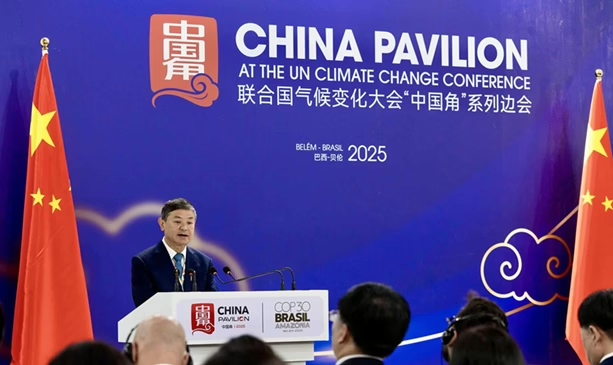
At last year’s COP30 summit in Brazil, China focused heavily on trade-related issues, pushing language against “unilateral measures” that restrict green trade and backing new climate-trade dialogue mechanisms.
Executive vice-premier Ding Xuexiang urged countries to “remove trade barriers and ensure the free flow of quality green products.” Tighter mitigation commitments were not a prominent objective.
Chinese firms dominate global supply chains in solar panels, lithium-ion batteries, grid storage, hydropower equipment and ultra-high-voltage transmission, and are highly competitive in wind and electric vehicles.
Xi’s proposals for the next Five-Year Plan also point to increased investment in hydrogen energy and nuclear fusion. These sectors deliver a triple dividend for Beijing: growth, energy security, and technological self-reliance.
There is also a structural pressure at work: overcapacity. Years of state support and local competition have produced fierce price wars and thin margins in several green sectors, which Chinese officials call “involution.” Expanding overseas markets helps absorb excess supply and stabilize major firms.
The upside of China’s clean-tech surge is clear: it is driving down the cost of decarbonization. Cheaper equipment makes energy transitions more affordable worldwide. But fears of dependence are rising too.
A wave of low-cost Chinese green exports could crowd out domestic producers elsewhere and deepen supply-chain vulnerabilities.
Western governments could respond by better aligning their investment and trade policies with climate goals. They could also press China to clarify and strengthen its vague assurance that it will “strive to do better” than its current emissions targets. For now, however, they lack unity and resolve on both fronts.
For business, the direction is clearer. Emerging green sectors will keep receiving strong policy support in China and will be encouraged to expand abroad through local manufacturing and joint ventures.
Chinese companies are likely to remain cost leaders across many clean-technology industries, leaving competitors to differentiate through specialization, systems integration and high-end innovation.
The era when climate cooperation was siloed away from economic competition in relations with China is ending. Beijing’s climate diplomacy now looks more like trade diplomacy.
(The Wire China)