Rekpene Bassey
The rumours had lingered for months in Nigeria’s political ether: whispers of illhealth, fatigue and speculation about tenure, muted agitation within the ranks.
Then the announcement came with the abruptness that often characterizes transitions in Abuja.
The retirement of former Inspector-General of Police, Kayode Egbetokun, finally ended the guessing game; bringing closure to a tenure extended by statute and contested in public discourse.
The new four-year tenure provision enacted by the National Assembly two years ago had effectively shielded the office from the traditional cycle of service-year calculations.
Paradoxically law cannot silence public sentiment forever. When the curtain fell, it did so amid accumulated expectations.
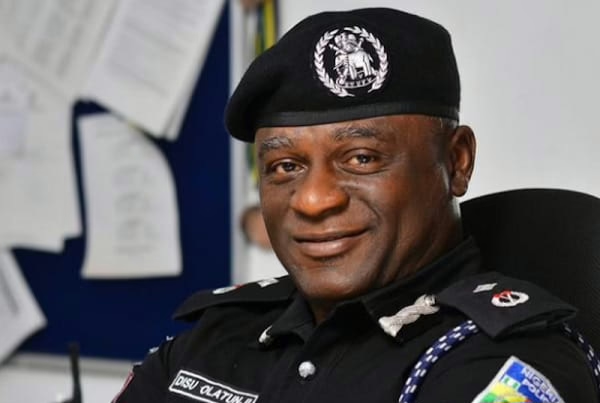
Expectations that now rest squarely on the shoulders of the new Inspector-General of Police ( IGP), Tunji Disu.
Leadership transitions in security institutions are never mere bureaucratic reshuffles.
They are inflection points. They recalibrate command hierarchies, alter institutional psychology, and send subtle signals across the federation’s volatile security landscape; from the forests of the North-West to the creeks of the Niger Delta and the restless urban sprawls of Lagos and Abuja.
Disu’s elevation inevitably triggers the retirement of several Deputy Inspectors-General and senior Assistant Inspectors-General under established policy.
Such cascading exits are not merely administrative; they tell on security resources, and reshape the command architecture of the Nigeria Police Force (NPF).
In security doctrine, continuity matters, but so does renewal.
As the Latin maxim reminds us, tempora mutantur, et nos mutamur in illis – times change, and we change with them.
The Nigeria Police Force stands today at a crossroads. It is at once overstretched and under-trusted; constitutionally empowered yet operationally constrained; visible in numbers but often invisible in intelligence-led prevention.
Reform is no longer a rhetorical flourish. It is a national security imperative.
Disu’s past tenure as commander of the Lagos State Rapid Response Squad offers a template of tactical discipline and responsiveness.
Lagos, Nigeria’s economic nerve centre, demands agility, coordination, and situational awareness.
The question before him now is whether that model can be scaled nationally across 36 states and the Federal Capital Territory.
At the heart of the reform agenda must be legitimacy. Security institutions derive their ultimate strength not from arms but from public confidence.
The police officer on patrol represents the state in its most immediate form. When that representation is tainted by extortion, brutality, or impunity, the state itself is diminished.
The culture of roadside extortion remains perhaps the most corrosive daily encounter between citizens and the police. It is petty in scale but catastrophic in symbolism.
Each corrupt demand for money is a small act of institutional sabotage. Stopping this culture is not merely about discipline; it is about restoring the moral authority of the uniform.
The withdrawal of police personnel from VIP protection duties, in line with the directive of President Bola Tinubu, represents another defining test.
For decades, Nigeria’s policing priorities have been inverted; concentrating manpower around the powerful while leaving vast communities either under-policed or completely unpoliced.
A recalibration toward community protection would signal a structural shift in operational philosophy.
But redeployment alone will not suffice. Officers returning from VIP assignments must be retrained, reoriented, and integrated into intelligence-led policing frameworks.
Modern law enforcement depends less on roadblocks and more on data, surveillance analytics, inter-agency fusion centres, and proactive threat mapping.
Nigeria’s security environment is hybrid in nature. Banditry in the North-West blends into terrorism.
Separatist agitations intersect with organized crime. Kidnapping has evolved into an industry.
Cybercrime networks exploit global vulnerabilities.
The police cannot operate as though crime were static or localized. Strategy must match complexity.
The reform agenda must therefore prioritize three pillars: institutional integrity, operational modernization, and inter-agency synergy.
Institutional integrity begins with internal accountability. Transparent disciplinary mechanisms, digitized complaint systems, and independent oversight structures would reduce impunity.
Promotions must reward merit and professionalism rather than patronage.
In classical thought, Cicero wrote that the welfare of the people shall be the supreme law – salus populi suprema lex esto. This maxim must animate police culture.
Operational modernization demands investment in forensic capacity, communications infrastructure, and technology-driven crime tracking.
Many criminal prosecutions collapse not for lack of suspects but for lack of evidence management.
Strengthening forensic laboratories and evidence chains would elevate conviction rates and deter crime more effectively than sporadic raids.
Inter-agency synergy is equally critical. The police do not operate in isolation.
Coordination with the military, intelligence services like the Department of State Services, National Intelligence Agency, civil defence corps, and regional security outfits must transcend rivalry. National security is a mosaic; fragmentation weakens it.
Human rights compliance must underpin every reform effort.
Respect for constitutional liberties is not a concession to activists; it is a strategic necessity. Excessive force radicalizes communities and fuels cycles of resentment.
Professional policing and human rights are not adversaries. They are complements.
Community policing, long proclaimed but inconsistently implemented, must move from slogan to system.
Traditional rulers, civil society groups, and local vigilante networks can serve as force multipliers. More so if structured within legal frameworks. Intelligence flows best where trust exists.
The welfare of officers themselves must not be ignored. Poor remuneration, inadequate housing, and psychological stress create fertile ground for corruption and misconduct.
Reform that overlooks welfare is reform in name only. An officer who feels abandoned by the state is unlikely to embody its highest ideals.
Disu’s challenge is therefore both managerial and symbolic.
He must reassure the rank and file while convincing a skeptical public that change is possible. He must enforce discipline without alienating morale.
He must balance firmness with fairness.
History offers reflective tales. Institutions resist transformation. Entrenched interests rarely yield quietly.
Nonetheless moments of transition create rare windows for decisive leadership.
The Roman historian Tacitus warned that the desire for safety stands against every great and noble enterprise.
Courage, administrative and moral, will be indispensable.
If executed with clarity and resolve, this agenda could redefine policing in Nigeria.
If neglected, the opportunity may dissolve into another cycle of public disappointment.
The sands of time are unforgiving. Names endure not because of office held, but because of institutions transformed.
For IGP Tunji Disu, the path ahead is steep but historic.
The mandate is clear: restore integrity, rebalance priorities, modernize operations, and align the Nigeria Police Force with the democratic aspirations of the Nigerian people.
In the end, the measure of his tenure will not be the length of service but the depth of reform.
And in a nation yearning for security anchored in justice, that measure will define not only a career, but a legacy.
Bassey is the President of the African Council on Narcotics, Drug Prevention and Security Specialist.
⁹