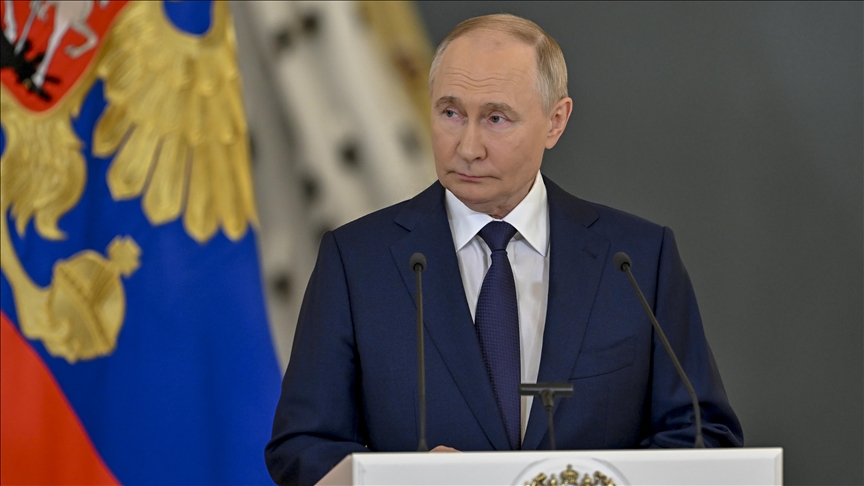
Vladimir Putin addressed the plenary session of the 23rd annual meeting of the Valdai Club, which this year took place under the theme “Responsibility for the Future: Limits of the Possible or Infinite Possibilities?”
Moderator Fedor Lukyanov, opening the session, noted that the club’s annual report was titled “No Panic” and encourages people “not to fuss” in the current situation.
Putin responded that serious problems have not disappeared as a result.
Putin said that some experts were likely to ask why Russia speaks of peace despite launching a war itself. “The truth is that we didn’t want this and we didn’t start fighting, others started fighting against us,” he said.
According to Putin, the West spent years encouraging “aggressive nationalism and Russophobia” in Ukraine in order to turn the country into a “tool” against Russia.
He claimed that NATO planned to establish bases on what he described as “our historical territories” and alleged that “radicals in Kyiv” were pushed toward a “coup d’état.”
The president also mentioned what he called “plans to set up concentration camps” for residents of Donbas and Crimea, and spoke of killings of unarmed people “just for being Russian.”
Putin claimed that Russia was deliberately put in a situation where it had to defend itself by force, and argued that “the destruction of Russia” had been elevated to the level of state ideology.
Concluding this section of his speech, Putin called for “living in harmony,” noting that trust is difficult to build and easy to destroy.
Putin said that it was “quite likely” international conflicts would continue in the coming years, arguing that radical changes stoke ambitions and a willingness to take risks for major gains.
He said he hoped his forecast would prove mistaken.
In the longer term, Putin argued that moving away from “Western hegemony” would result in a more stable multipolar order, though the path would come with risks.
The president said that in global politics, “every conceivable and inconceivable taboo” is now broken almost daily, but did not provide specific examples, stating that “everyone here already understands.”
He criticized the failure to fulfill commitments, deception, replacing dialogue with propaganda, and “mocking the facts,” as well as the idea that “if you have strength, you don’t need brains”—a principle he said some actors follow out of a belief in their own exceptionalism.
Putin stated that some international structures do not reduce risks but create them, serving the interests of a single country or group of states.
He argued that the United Nations is managed far less collegially than intended, as Western countries have a disproportionately large influence, despite making up “a clear minority globally.”
Putin said that Russia supports UN reform with a larger role for Asia, Africa, Latin America, and the Middle East, although reaching a consensus is currently difficult.
He added that reform should not be limited to expanding the Security Council. According to the president, new groupings such as BRICS have potential, but still need to define their functions and limits. He said it was unrealistic to expect them to quickly create a multipolar world.
Putin mentioned the idea of “careful digitalization,” meaning rejecting the uncontrolled deployment of artificial intelligence in areas sensitive for moral development.
Citing experts, he warned that AI could become a tool of “depersonalization” through “externally programmed algorithms,” and compared such “digital totalitarianism” to totalitarian societies of the past. He singled out digital sovereignty for states as another pressing issue.
Putin also addressed human intervention in what was once regarded as the “prerogative of the Creator”—genetic changes, personality formation, and “programming” behavior and thinking.
He argued that decisions in this area should be found through joint international efforts.
Putin said that anxiety over change was causing “domestic political fever” in many countries, in part because traditional party systems are no longer reflecting the structure of society.
According to him, to preserve stability at home, governments may seek to “export” instability to neighboring countries or the world as a whole.
A day before Putin’s address, Reuters reported on a closed diplomatic note in which Moscow threatened NATO with nuclear weapons if the alliance attempted to isolate the Kaliningrad region from the rest of Russia.
In a written response, the alliance described itself as a defensive grouping and called on Russia to end its invasion of Ukraine and to abandon “irresponsible nuclear rhetoric.”
(UAWire)