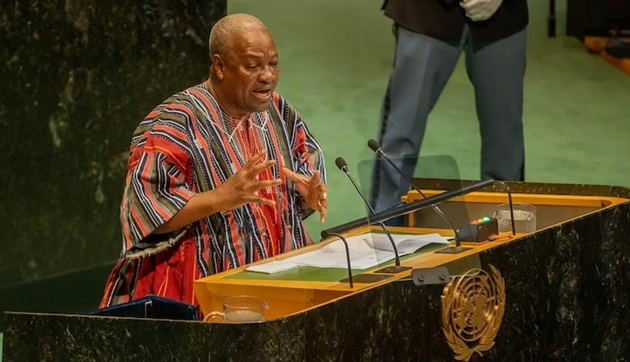
Ghana and the African Union recently pushed through a United Nations resolution calling for recognition of “the trafficking of enslaved Africans and the radicalized chattel enslavement of Africans as the gravest crime against humanity.”
The March 25 resolution’s supporters say the U.N. vote bolsters the global push for reparations. The list of who voted for it, against it, and abstained reveals the nations that still don’t want to acknowledge the legacy of more than 400 years of slavery inflicted on people of African descent.
The resolution was adopted with a 123-3 vote, with Argentina, Israel, and the U.S. voting against, and 52 countries, including the United Kingdom, all European Union members, and Canada, abstaining. U.N. resolutions are not legally binding, but they influence global norms and help guide nations in identifying what they consider harmful.
Ghana presented the resolution during the U.N.’s annual commemoration of the International Day of Remembrance of the Victims of Slavery and the Transatlantic Slave Trade. Supporters say the strategy was to gain global recognition first, then use that positive vote to pressure for educational, developmental, and debt-justice reparation policies.
The nation of Venezuela couldn’t vote on the resolution since it had lost its voting rights in the General Assembly because of unpaid dues, but Venezuelan anthropologist Diógenes Díaz Campos, an executive committee member of the Afrodescendant Coordination for Latin America and the Caribbean (ARAAC) and a delegate tied to the Network of Afro-Venezuelan organizations, said his government’s political stance has stayed in line with reparations efforts that it last officially proclaimed in 2015.
“We are delighted with this historic victory for humanity, not just for people of African descent,” Díaz Campos wrote in a social media post. “Personally, I am pleased that Venezuela is one of the few countries to have supported this draft resolution, which has now been adopted.”
Díaz Campos said that activists now need to use the impact of the U.N. vote as a symbol across Latin America, the Caribbean, and Africa; it should serve as a call to action for real policy changes in national legislatures, regional organizations, and the United Nations human rights system.
British diplomats explained their abstention vote by saying the U.K. recognizes “the gravity of the issues addressed in this resolution” and has “repeatedly recognized the abhorrent nature of slavery and the transatlantic slave trade,” but could not support what it called the text’s “fundamental propositions.”
Britain said it could not agree with the resolution’s claim that the trafficking and racialized chattel enslavement of Africans was the “gravest” crime against humanity.
The UK warned against “creat[ing] a hierarchy of historical atrocities,” and argued against judging past actions by legal rules developed later.
However, this cautious diplomatic approach might not sit well with British citizens. Activists in Britain are already questioning the root causes of the nation’s wealth, institutions, and racial inequalities.
Recent books such as “The Crown’s Silence: The Hidden History of the British Monarchy and Slavery in the Americas” by Dr. Brooke Newman tell how the British navy and monarchy spent centuries supporting and profiting from the trade in enslaved Africans.
Just this month, the University College London Center for the Study of the Legacies of British Slavery received a $575,000 grant to help develop a database focused on the lives of enslaved people in British colonies.
Bell Ribeiro-Addy, a Labour Party member of Parliament and a prominent reparations advocate, said her country’s abstention read less like legal caution than political refusal.
“Britain’s refusal to support Ghana’s resolution at the U.N. suggests our government is not interested in acknowledging or addressing the legacy of our country’s involvement in some of the gravest crimes against humanity,” Ribeiro-Addy told the Amsterdam News.
“It tells Black Britons that their government is not interested in getting to the roots of the racism we continue to face at home. It tells former Commonwealth countries that Britain isn’t interested in dialogue about how we might build more equitable partnerships.
It leaves us on the wrong side of history and more isolated on the world stage.
“I submitted a Parliamentary petition on behalf of the [All-Party Parliamentary Group; APPG] for Afrikan Reparations, urging an apology for Britain’s role in the trafficking and enslavement of African peoples and the establishment of an All-Party Parliamentary Commission for Truth and Reparatory Justice,” Ribeiro-Addy added.
“I am not holding my breath for a response, but the APPG will continue to operate as a bridge between the grassroots reparations movement and the UK Parliament, including at our annual UK Reparations Conference in October.”
Ribeiro-Addy’s warning is the same in the Caribbean, in Africa, and in British Commonwealth governments.
Many of them have pressed the UK to move from remembrance to repair; Britain’s abstention, critics say, reinforces the sense that London wants to partner with its former colonies but not address past harms.
Canada, another Commonwealth nation, also abstained, a decision advocates said resonated at home because it conflicted with the country’s public commitments to human rights and Black history.
Hodan Ahmed Mohamed, co-founder of the Black Canadians Civil Society Coalition, said Canada’s abstention hit differently in a country that likes to cast itself as a refuge in the history of slavery.
That national story, she said, often skips over Canada’s place in the British Empire, and the anti-Black exclusion that followed Black settlers north.
She said advocates have reached out to the government in Ottawa, looking for an explanation, and have not yet received one.
“We haven’t really heard anything back from them, which is an embarrassment,” Mohamed said, adding that she planned to raise the abstention directly with Canada’s UN mission in Geneva.
Mohamed disputed the premise that a “yes” vote would have automatically opened Canada to immediate reparations claims.
“This was not a legally binding resolution,” she said; it was at most a baseline acknowledgment for establishing expectations for what comes next.
“It … basically signals to Black Canadians or Black people in Canada that their humanity and human rights is an afterthought,” Mohamed said.
She added that in Canada, reparations work is still stuck at the level of formal recognition of Afro Canadians: “The legal recognition has to be established first before we even move on into any form of reparations,” she said, describing “a fight to make anti-Black inequities a federal obligation rather than a political choice that shifts with every election.”
(Amsterdam News)