Government officials, financiers, and real estate developers are exploring cheaper construction models that can make it easier to deliver 200,000 affordable housing units annually.
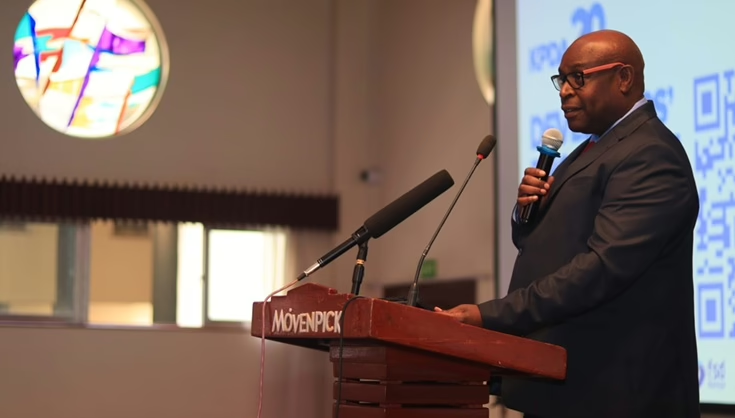
The industry players met in Nairobi during a forum convened by the Kenya Property Developers Association (KPDA) this week to examine how joint efforts, from groundbreaking to delivery of the houses, can be made faster
Housing Secretary and director of estates management Cassius Kusienya, who spoke on behalf of Principal Secretary Charles Hinga, noted that 262,913 affordable units are currently under construction across the country, with 8,367 completed to date.
He said the State Department is relying heavily on private-sector participation to scale delivery, citing tax incentives such as the VAT exemption program, which has supported the development of 13,622 units.
“The program is moving from frameworks to physical assets, converting the entire country into one massive construction site,” said Kusienya.
The secretary pointed to the Affordable Housing Act 2024 as the framework now guiding nationwide implementation, noting that the program is shifting from planning to on-the-ground construction.
Affordable Housing Board member John Kimani said that a standardized developer engagement framework is being developed through which KPDA and Kenya National Chamber of Commerce and Industry consortium will join as institutional partner.
This will enable private developers to participate in delivering affordable housing units that the board will off-take for Kenyan homebuyers.
Data shared at the event indicated that the Affordable Housing Program has generated more than 525,000 jobs since 2022 and channelled over Sh11 billion to MSMEs and Jua Kali suppliers.
The experts examined replication strategies, financing models and practical constraints facing developers.
Kenya is facing a housing emergency, with the numbers showing that the country needs 260,000 new homes every year to keep up with demand, yet the formal market is delivering fewer than 60,000.
In this widening chasm, private developers are stepping up, racing to build the homes that millions of Kenyans desperately need.
This has seen the deficit now stand at a staggering two million units.
A drive through Westlands, Kilimani, South C or Eastleigh reveals a cityscape dominated by construction projects towering high-rise flats and apartments that are encroaching on Nairobi’s streets.
This, as developers rush to complete their projects on rising housing demand.
KPDA chairman Ken Luusa positioned the association as a conduit between private developers and government.
“The private sector is ready. Government has laid out its priorities. The question is whether we can build the bridge between them that allows both sides to meet their objectives,” he said.
Developers presented case studies detailing what has worked in their previous projects.
Harveer Singh of Landmark Holdings discussed the use of aluminum formwork in delivering more than 1,000 units at Konza.
Mumo Kianga of Mi Vida Homes and Kioi Wambaa of IHS Kenya described their 200-unit green-certified development at Garden City and plans for an additional 4,000 units.
(Star)