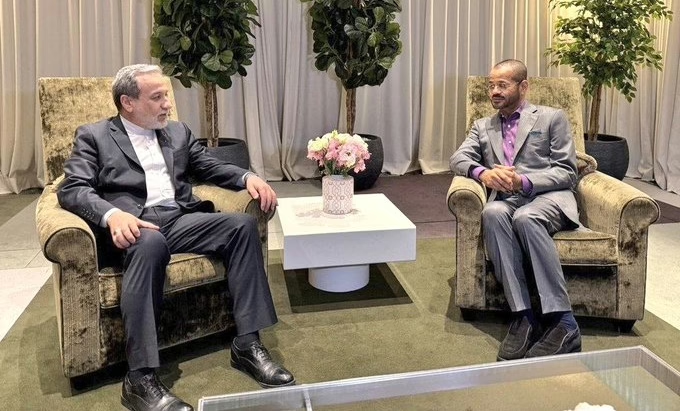
The third round of U.S.-Iran nuclear talks is set to kick off Thursday in Geneva amid heightened tensions between Tehran and Washington, as President Donald Trump threatens military action if a deal is not made.
Foreign Ministry spokesman Esmaeil Baghaei of Iran told reporters that Tehran’s delegation has come fully prepared.
“Right now, the relevant experts in the fields of sanctions relief and economic issues, as well as nuclear and legal matters, are with us, and we are prepared to continue these talks as long as necessary,” he said, the Islamic Revolutionary Guard Corps-affiliated Fars News Agency reported.
“As far as we are concerned, we are here with full preparedness and seriousness in order to realize the country’s national interests.”
He added that they will be watching for “contradictory statements” between what U.S. officials say in the meetings and what they tell the press.
“These contradictions do not help advance this diplomatic process and increase doubts and suspicions about their purpose and intentions,” he said.
Rafael Grossi, the director of the United Nations’ International Atomic Energy Agency watchdog, was in Geneva for the talks.
Oman’s Foreign Ministry posted a picture of Minister Sayyid Badr bin Hamad Al Busaidi meeting with Grossi Thursday morning for discussions on technical matters related to Iran’s nuclear dossier, as well as “new ideas” under negotiation. The IAEA has yet to comment on the meeting.
The second round of talks was held in the middle of last month, with Araghchi stating that an agreement had been reached “on general guiding principles.”
However, significant gaps remained between the United States and Iran.
Though officially beginning Thursday, Iran’s ministry said in a statement that Minister Seyed Abbas Araghchi met with his Omani counterpart, Al Busaidi, on Wednesday night and conveyed Tehran’s views on nuclear-related issues and the lifting of sanctions.
Araghchi stressed to the representative of Oman, which is mediating the talks that “the success of the negotiations depends on the seriousness of the other side and its avoidance of contradictory behavior and positions.”
Trump has pursued a new nuclear deal with Iran since early in his first term, when in 2018 he unilaterally withdrew the United States from a landmark Obama-era multinational accord aimed at preventing Tehran from securing a nuclear weapon.
The first Trump administration applied a maximum pressure campaign of sanctions and economic pressure to coerce Tehran back to the negotiating table. Under the economic coercion, Iran began breaching its nuclear commitments and advanced its enrichment program.
Then, under the Biden administration, the United States attempted to revive negotiations with Iran — an effort that stalled by the fall of 2022 and was shelved when Iran-backed Hamas attacked Israel on Oct. 7, 2023.
Last June, after Trump was elected to a second term, he ordered strikes on three known nuclear sites as the United States joined Israel’s military campaign against Tehran.
The White House later claimed Iran’s facilities had been “obliterated,” though international inspectors have not been able to gain access to them to verify the extent of the damage.
Despite the assertion, Trump has expanded the United States’ military presence in the Middle East in recent weeks ahead of the talks, sparking worries it may precede another attack if negotiations falter.
During his State of the Union address to a joint session of Congress on Tuesday night, Trump said Iran is seeking to restart its program but also wants to make a deal with the United States.
“They are at this moment again pursuing their sinister ambitions,” he said without providing proof. “My preference, my preference is to solve this problem through diplomacy.
“But one thing is certain, I will never allow the world’s No. 1 sponsor of terror — which they are by far — to have a nuclear weapon. Can’t let it happen.”
(UPI)