Aliyu Inuwa Mansir
For years, traders and commuters along Murtala Muhammed Way in Kano metropolis have endured a persistent and offensive stench that hangs over the area daily, disrupting business activities and raising serious public health concerns.
A SolaceBase investigation has uncovered that the pollution is not accidental but largely the result of industrial wastewater discharged into open drainage channels by nearby oil-producing and processing companies.
Findings from the investigation indicate that the discharge often occurs in the evening, a period when commercial activities slow down and regulatory presence is minimal.
The wastewater, believed to be untreated or poorly treated, flows through open drains linking industrial zones in Nasarawa Local Government Area to major commercial routes, contaminating the air and leaving behind a choking odour that lingers well into the following day.
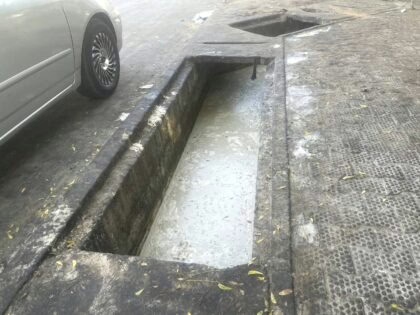
By morning, when traders open their shops and commuters resume movement, the polluted air has already spread across the corridor.
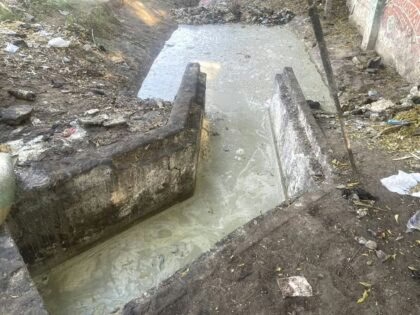
What should be a vibrant commercial environment instead becomes a hostile space, forcing people to trade, work, and pass through amid nausea, headaches, and breathing discomfort caused by prolonged exposure to the fumes.
Despite repeated complaints from those affected and the scale of daily exposure, the practice has persisted, turning a vital economic hub into a pollution hotspot where livelihoods are threatened, and health risks continue to mount.
Uncovering the actors behind the discharge
Along Tafawa Balewa and Maganda Roads in Nasarawa Local Government Area, several groundnut oil-producing and processing companies operate.
Findings from SolaceBase investigation indicate that the polluted water flowing through drainage channels along Murtala Muhammed Way is linked to activities at Fortune Oil Mills Nigeria Limited, PS Mandridis, and Aminu Dawaki Oil Mills.
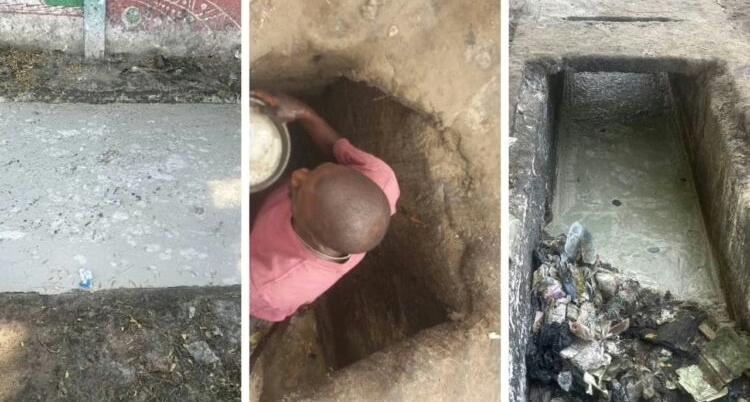
Wastewater discharged by these companies flows through open drainage channels that lead directly toward Murtala Muhammed Way, polluting the surrounding air.
Drains originally designed for stormwater have gradually become conduits for industrial waste, exposing thousands of traders, commuters, and residents to daily environmental pollution.
Traders recount years of silent suffering
Every evening, as business activities wind down along Murtala Muhammed Way, a different routine begins-one that traders and commuters dread.
At exactly 9:00 a.m. each morning, Mallam Saminu Kamal opens his small shop, as he’s been doing for more than three decades. He grew up by the road, married there, and raised his children in the same environment. But by nightfall, he says, the area becomes hostile.
“In the evening, the smell comes,” Kamal said quietly. “It is unbearable.”
A sharp, choking stench rises from the open drainage channels cutting through the commercial corridor, spreading into shops, offices, and pedestrian walkways.
Traders describe hours of nausea, headaches, dizziness, and breathing discomfort-conditions they say have become part of their daily reality.
“I built my life here,” Kamal added. “But now, the air is killing us.”
Another trader, Ibrahim Muhammad, said the discharge follows a pattern.
“They release it mostly at night, between 8:00 and 9:00 p.m., after banks have closed,” he said. “On weekends, it is either early in the morning or late in the evening.”
According to him, the timing is deliberate.
“They know banks can fight back. But traders and commuters have no voice. We are the ones paying with our health.”
Allegations of calculated discharge timing
Traders insist the release of foul-smelling wastewater at specific periods is intentional rather than accidental, arguing that the timing appears carefully planned.
“They never release it randomly,” Muhammad said.
SolaceBase further uncovered that the suspected discharge often occurs at times when regulatory agencies and environmental health officers are less likely to be on duty, a pattern traders say makes monitoring and accountability difficult.
When enforcement worked and failed
The pollution problem is not new. Salisu Sani, a trader, recalled a period when regulatory enforcement made a difference.
“During former Governor Rabi’u Musa Kwankwaso’s second tenure, which was around 2015, there was serious action,” he said. “The banks complained, and the companies treated their water. The smell stopped.”
However, the relief was short-lived.
“In recent years, the dirty water returned, worse than before,” he added.
Health costs on the roadside
For many traders, the impact is immediate.
“The smell gives me headaches and makes me vomit,” Sani said. “I can’t eat here. I have to leave my shop just to eat.”
Sabi’u Umar, who sells fuel on the black market along Murtala Muhammed Way near a drainage channel, described the situation as a serious health concern.
“I have been doing this business by the roadside for over two years,” Umar said. “The water is smelling badly, and we are not happy. Most times, the smell gives me headaches.”
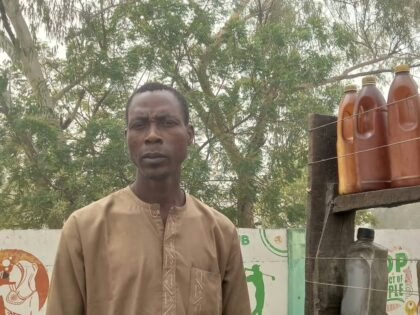
Despite the conditions, Umar said he has no alternative.
“I am just managing to survive here. I cannot leave this place because I don’t know where else to go,” he added, calling on the government to intervene.
Fruit sellers lose customers
Usman Ibrahim, a fruit trader who has sold along the roadside for about ten years, said the situation worsens during the hot season.
“When the sun hits the water, the smell increases,” he said. “Sometimes we lose customers because people cannot stand it. They just pass and move on.”
According to him, customers often ask about the smell before buying.
“We try to convince them that the smell is coming from the oil companies, not from our fruits,” Ibrahim said. “But it is difficult to convince them.”
Another fruit seller, Abubakar Alhassan Dan Zaki, said the smell is currently less severe due to the cold season.
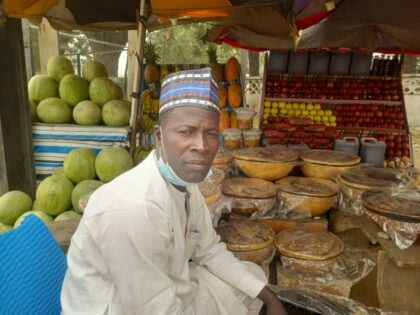
“Now it is not disturbing us too much,” he said. “But during the hot season, it is very serious. I have been here for years, and nobody has come to our rescue.”
Drainage blockage worsens pollution
Beyond industrial discharge, the investigation uncovered a disturbing practice that worsens the situation.
Abubakar Zubairu Shuaibu, who works at the Kano Golf Club and trades as an additional source of income, blamed human activities for blocking the drainage.
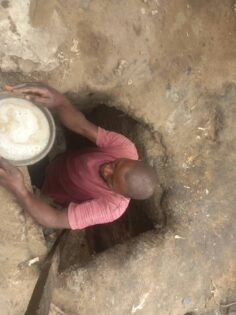
“Some people deliberately block the water from flowing properly,” he said. “When companies channel the water, instead of allowing it to pass, these people stop it and collect the same.”

According to him, the water is taken for commercial use.
“They use the water to make soup and sell it,” he said. “They make money, but it hurts us. If the water flowed freely, the smell would not be this bad.”
‘This water feeds us’
Those involved in blocking the drainage did not deny the allegations.
Nasar Usman admitted to collecting wastewater.
“The wastewater comes from an oil-producing company along Tafawa Balewa Road,” he said. “When the company is working regularly, we are happy because we collect the water and sell it to people in the Dakata area.”
Usman said the activity is his main source of livelihood.
“Through this business, I sponsored my secondary and university education. I am now married with children,” he said. “This is the only business I have.”
He dismissed concerns about health risks.
“The smell does not disturb us,” he said. “We even use the water to wash our clothes.”
Doctor warns of long-term damage
Dr Aminu Bala of Aminu Kano Teaching Hospital warned that prolonged exposure to industrial emissions, particularly chemicals such as hexane used in oil processing, can cause long-term health damage.
“Headaches, nausea, dizziness, and eye and throat irritation are early warning signs,” he said.
“Long-term exposure can lead to chronic respiratory disease, aggravated asthma, and nerve damage.”
He also warned that polluted wastewater could contaminate groundwater and boreholes.
Government admits unsafe pollution levels
An air quality assessment conducted by the Kano State Ministry of Environment and Climate Change between May 26 and May 30, 2025, found pollution levels in parts of Kano metropolis unsafe for public health.
The Director of Pollution Control, Mallam Ibrahim Nasir, said enforcement had begun.
“Companies are required to install primary wastewater treatment plants,” he said, adding that firms have been given between one and six months to comply or face closure.
He added that the state government, in partnership with the Federal Government through the Ecological Fund Office and with UNIDO’s technical support, is constructing secondary wastewater treatment plants near affected industrial zones.
He said secondary wastewater treatment plants are being built in Challawa, Bompai, and Sharada as a response from the government to address the issue.
Companies respond as blame shifts
Bashir Salisu Burji, General Manager of Fortune Oil Mills Nigeria Limited, said the company cleans its drainage annually but blamed the persistent stench on other factors.
“We clean our drainage every year to avoid smells,” he said. “Even this year, I personally led the cleaning. But some people block the water. We had to involve the police to chase them away.”
When asked whether the company operates a primary wastewater treatment plant, he declined to respond and referred our reporter to the company’s Chief Security Officer, Mallam Rabi’u Danjuma, to arrange an interview with a senior manager.
When contacted, Danjuma initially said he would get back to the reporter. He later stated that the manager who granted the initial interview was in the appropriate position to facilitate discussions with senior management, not him in his capacity as Chief Security Officer.
However, he promised to reach out to Bashir Salisu Burji, the General Manager, for further directives. Despite repeated follow-ups over a period of two weeks, the interview was not granted.
Mallam Yusuf Alhassan Munjibir, Human Resources Manager of PS Mandridis, denied discharging polluting wastewater.
“Our company does not process soybean oil and only produces groundnut oil on a very limited scale, sometimes once or twice within a six-month period.”
He added that offensive odours are typically associated with solvent-based extraction systems, which the company does not use.
“PS Mandridis has also been affected by the polluted drains in the past. At one point, we had to close our windows and even relocate our office within the company premises to a direction where the smell would not enter,” he said.
Muhammad Alhassan, Personnel Manager of Aminu Dawaki Oil Mills, acknowledged the odour problem and said the company is taking steps to address it.
Describing the firm as law-abiding, he disclosed plans to construct a primary wastewater treatment plant to tackle the issue.
“We are law-abiding people. Our company is relatively new compared to others. We are aware that the water is smelling, and we are working to address it.
“As I speak to you now, we are about to sign a contract with a company that will construct a primary wastewater treatment plant. Your visit will also serve as a reminder, and I will raise the matter during our management meeting,” he said
As government deadlines draw closer and companies trade explanations, traders and commuters along Murtala Muhammed Way continue to inhale polluted air night after night.
This report was done with support from Civic Media Lab