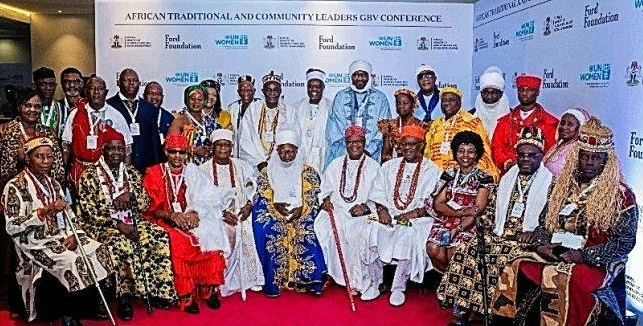
Traditional rulers, government officials, and development partners from across Africa have renewed commitments to accelerate coordinated efforts to end gender-based violence (GBV) on the continent.
This was made known during the opening ceremony of the Conference of African Traditional and Cultural Leaders on GBV Prevention, in Lagos, South West Nigeria.
The two-day conference, convened by the Ford Foundation and UN Women in collaboration with the Government of Nigeria, aims to mobilise traditional institutions and cultural authorities as key drivers of social change, justice, and protection for women and girls.
Speaking on behalf of the Lagos State Governor, the Commissioner for Health, Professor Akin Abayomi, described GBV as a major threat to societal stability, stressing that silence is no longer acceptable and that intentional action is required to build safe and just communities.
“Silence about GBV is no longer acceptable; change must be intentional. Africa’s future depends on safe laws and just communities that nurture rather than harm,” he stated.
Ford Foundation President, Heather Gerken emphasised the importance of cultural legitimacy in driving progress, noting that collaboration with faith and traditional leaders is critical to transforming harmful social norms and enabling women and girls to reach their full potential.
“The foundation is proud to collaborate with faith and traditional leaders working to transform harmful social norms,” she said
UN Women Deputy Executive Director, Nyaradzai Gumbonzvanda, highlighted structural drivers of abuse, pointing to practices such as child marriage as manifestations of systemic inequality that require institutional and normative reforms.
“Gender-based violence is not the root problem; it is one of the clearest symptoms of the need to affirm norms and institutions that ensure equality and justice for all,” she revealed.
Dr. Maxime Houinato of UN Women described traditional and cultural leaders as architects of social order, arguing that aligning cultural authority with justice, dignity, and equality is essential for safer communities and legitimate institutions.
Reinforcing this position, Dr. Chichi Aniagolu said culture is dynamic and shaped by leadership, warning against using tradition to justify harmful practices.
The Emir of Shonga, HRH Alhaji Dr. Haliru Yahaya Ndanusa, also cautioned against religious justification for violence, stating that any practice that causes harm contradicts Islamic principles.
“Violence against women and girls remains a serious challenge across Africa, affecting families, communities, and the future of our societies.
“As traditional leaders, we cannot remain bystanders. Our authority, influence, and close connection to our communities place a clear responsibility on us to speak out and to act.
“Culture must never be used to justify harm. Rather, culture should be a force that protects dignity, promotes justice, and ensures the safety and well-being of women and girls.
Across Africa, we are seeing encouraging examples where traditional leaders are challenging harmful practices, promoting accountability, and supporting survivors.
This conference provides an opportunity to learn from one another, strengthen our resolve, and scale up what works.” He reiterated.
UN Assistant Secretary-General and Resident and Humanitarian Coordinator in Nigeria, Mohamed Malick Fall, urged traditional authorities to leverage their influence to promote dignity, equality, and protection at the community level.
The conference concluded with a Regional Declaration and Communiqué, as well as a Sustainability Roadmap to integrate traditional leadership into national and regional GBV prevention frameworks.
The outcomes were designed to strengthen partnerships among traditional councils, governments, African Union institutions, and civil society, improve survivor-centred referral systems, and mobilize resources for large-scale GBV prevention.
The conference brought together high-profile participants, including His Imperial Majesty, the Ooni of Ife, the Emir of Fika, Emir of Shonga, Chief Siansali of Zimbabwe, Ford Foundation President Heather Gerken, UN Women Regional Director for West and Central Africa Dr. Maxime Houinato, Ford Foundation West Africa Director Dr. Chichi Aniagolu, and UN Women Country Representative to Nigeria and ECOWAS Beatrice Eyong, alongside senior policymakers and civil society leaders.
(VON)