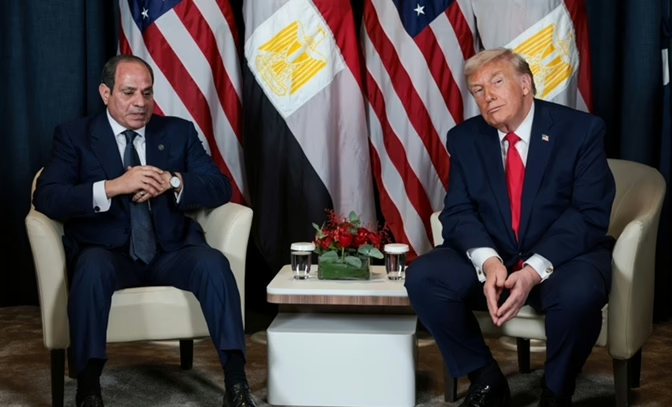
US President Donald Trump’s recent proposal to mediate the longstanding water-sharing dispute between Egypt and Ethiopia can, on the surface, be interpreted as a reciprocal gesture towards Cairo.
Egypt has maintained peace with Israel for decades, safeguarded the vital Suez Canal, served as a key US partner in security, intelligence, and military affairs, and played a pivotal role in brokering the fragile, yet enduring Gaza ceasefire.
Moreover, President Abdel Fattah al-Sisi’s decision to join the Board of Peace, which has drawn widespread criticism for its selective membership, lack of UN oversight, and opaque decision-making processes, lends the body much-needed international legitimacy. The board, chaired by Trump, has been formed to advance the US-led Gaza peace framework.
That said, Trump’s mediation offer arrives amid a rapidly evolving geopolitical landscape characterised by shifting power dynamics and regional alliances across the Middle East, the Red Sea, and the Horn of Africa.
Such timing inevitably invites scrutiny, prompting valid questions about the initiative’s true intention. Does Trump genuinely seek to resolve a simmering conflict, or does the move serve other strategic interests?
Lifeline under threat
At the heart of the Egyptian-Ethiopian dispute lies Ethiopia’s massive Grand Ethiopian Renaissance Dam (GERD) on the Blue Nile, the primary tributary feeding the Nile River, and Egypt’s sole reliable source of freshwater. The dam became fully operational in August 2025.
Since construction began over a decade ago, the multibillion-dollar hydroelectric project has evolved from a regional infrastructure initiative into a persistent source of anxiety for Egyptian policymakers.
A looming threat for the country’s 110 million people, who already face acute water scarcity, the dam poses a direct risk to Egypt’s long-term water security.
Prime Minister of Ethiopia Abiy Ahmed delivers his remarks during the official inauguration ceremony of the Grand Ethiopian Renaissance Dam (GERD) in Guba, on 9 September 2025.
Egypt relies almost entirely on the Nile for its freshwater needs, receiving an internationally recognised annual allocation of 55.5 billion cubic metres under existing agreements.
Nonetheless, the GERD’s enormous reservoir, comparable in size to Greater London—has already demonstrated its capacity to significantly disrupt that flow.
During the multi-year reservoir-filling phase, Ethiopia withheld significant volumes of Nile water that would otherwise have reached Egypt. Even now, as the dam generates power, it continues to restrict or control large portions of Egypt’s annual share.
In a recent address to parliament, Egypt’s Minister of Water Resources and Irrigation, Hani Sewilam, revealed that the country has spent tens of billions of Egyptian pounds on mitigation measures.
These include expanding wastewater treatment, scaling up seawater desalination, and investing in water-efficiency projects to shield ordinary citizens from the immediate impacts of reduced inflows.
These costly interventions have so far softened the blow, but Egypt is now bracing for far greater long-term losses.
In normal hydrological conditions, the dam already reduces available water. In the event of droughts—or prolonged dry spells, the consequences could be catastrophic, potentially triggering widespread economic disruption, agricultural collapse, and severe shortages in a nation already classified as water-stressed.
Egypt has already faced a harsh warning about the dangers ahead. In September and October last year, the unplanned release of large volumes of water from the dam during the rainy season flooded extensive stretches of the Nile Valley, inundating farmland and communities.
The damage was even more severe in Sudan, where an unrelenting civil war has left the country ill-equipped to prepare for or respond to such sudden floods.
Shifting regional landscape
President al-Sisi has repeatedly described the Ethiopian dam dispute as an ‘existential threat’ to his nation.
Despite Egypt’s efforts to resolve the issue through diplomacy, President Trump’s mediation offer arrives amid profound shifts in the regional geopolitical landscape, a shift that underscores Cairo’s decision to take matters into its own hands.
Over the last decade, Egypt has pursued every available political and diplomatic avenue, including pressing Addis Ababa to reach a legally binding agreement on the dam’s operation.
With those options exhausted, Cairo is now implementing proactive measures to safeguard its vital Nile water supply and prevent Ethiopia from wielding the dam as a tool of coercion.
Ethiopia has repeatedly denied such intentions. Yet the GERD, far exceeding the country’s domestic electricity needs or the requirements for power exports to neighbours such as Sudan and Djibouti—signals an imminent and dramatic shift in water-power politics in the Horn of Africa, and potentially beyond.
In response, Egypt has forged a network of military cooperation and mutual defence pacts with Ethiopia’s neighbours, including Eritrea, Somalia, Djibouti, Kenya, and Uganda. Egypt’s strategic encirclement of Ethiopia delivers a blunt warning to Addis Ababa: any move to restrict the Nile’s water flows will put Ethiopia within Cairo’s military and strategic reach.
These manoeuvres also aim to confine Ethiopia to its landlocked status, countering Addis Ababa’s bid for Red Sea access via a naval base in the self-declared independent region of Somaliland.
Meanwhile, an emerging Egyptian-Saudi alliance is poised to reshape influence across the Red Sea and Horn of Africa.
This partnership aims to bolster Somalia’s central government in Mogadishu and prevent national fragmentation. By reinforcing federal control over all territories, it seeks to thwart regional actors from exploiting Somalia’s coastline for strategic gains at the southern gateway to the Red Sea and Gulf of Aden.
High-stakes mediation
A direct military clash between Egypt and Ethiopia over the GERD could signal the beginning of a new era of water wars, setting a dangerous precedent for other water-stressed river basins worldwide.
For now, Egypt’s strategy of encirclement has effectively boxed Ethiopia in. Such deliberate containment makes it extremely difficult for Addis Ababa to pursue its long-standing ambition of securing Red Sea access without first reaching some form of understanding with Cairo.
It is this strategic tightening that fuels suspicion of Trump’s mediation offer. The offer can be viewed not as genuine peace-making, but as an American attempt to slam the brakes on Egypt’s momentum, debilitating its hard-won leverage, and dragging both sides back into protracted, inconclusive talks.
This scepticism is not unfounded. Although Trump has referenced the Nile dam dispute several times since returning to office, including most recently on 20 January, his renewed engagement coincides suspiciously with Egypt’s growing regional assertiveness in the Red Sea and Horn of Africa.
During the final months of his first term, Trump brokered a near-deal on dam construction, reservoir filling, and operation rules, only for Ethiopia to walk away at the last moment.
The draft text from that period remains, in the eyes of some Egyptian experts, including former water resources and irrigation minister Mohamed Nasr Allam, a ready-made framework that could quickly resolve the crisis if Addis Ababa were compelled to sign.
Should Trump succeed in reviving and enforcing that agreement, which includes ironclad protections during droughts and prolonged dry spells, Egypt stands to gain significantly without ever resorting to force.
Boys swim in the Nile River amid a heatwave in El Qanater El Khairiyah, Al Qalyubia Governorate, Egypt August 4, 2023.
Red Sea red line
A balanced accord that safeguards Egypt’s existential water needs, while allowing Ethiopia reasonable development rights, would represent a major diplomatic victory for Cairo.
Ethiopia, meanwhile, has no political obligation to accept terms that it perceives as constraining its sovereign control over a flagship national project.
Having already completed the dam and invested heavily in transmission infrastructure, Addis Ababa now anticipates substantial economic returns from domestic power generation and exports to neighbouring countries.
Nonetheless, a closer examination of Ethiopia’s domestic vulnerabilities and geostrategic isolation suggests another possibility: Addis Ababa may attempt to use the mediation process as leverage to extract concessions on its Red Sea ambitions.
This could include offering cooperation on dam operations in exchange for Egyptian acquiescence to an Ethiopian naval or commercial foothold on the coast.
Cairo, however, has repeatedly and categorically ruled out any such trade-off. This fundamental red line underscores just how delicate, and potentially explosive, Trump’s mediation mission will be.
(Al Majalla)