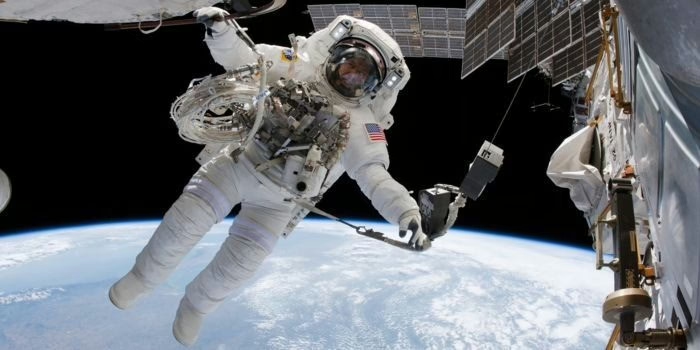
Kenya is set to make history in 2026 after being selected to host the Amateur Radio on the International Space Station (ARISS) program, a global initiative that enables the public to communicate live with astronauts aboard the International Space Station (ISS).
The Kenya Space Agency announced the selection, positioning the country at the heart of an international effort to advance space education and public engagement in science.
Kenya is the only African nation chosen for the 2026 ARISS cycle, a milestone expected to spark interest in science, technology, engineering, and mathematics (STEM) and inspire innovation across the country.
According to the agency, the hosting window will run between July and December 2026.
During this period, Kenyan students, professionals, and members of the public will take part in live radio sessions with astronauts on the ISS.
Participants will have the opportunity to ask questions and receive real-time answers about daily life in orbit, scientific research conducted on board, and the realities of living and working in space.
The ARISS program was created to make space more accessible by connecting astronauts directly with people on the ground.
For Kenyan learners, the experience offers a hands-on approach to STEM education, moving beyond traditional classroom learning to direct interaction with space professionals.
The Kenya Space Agency will oversee preparations for the event in collaboration with Pan-African Citizen Science e-Laboratory mentor and agency liaison Harold Safary.
Planning efforts will include technical coordination, public outreach, and the selection of participants, with an open call to be issued for interested individuals and institutions wishing to take part in the live ISS contacts.
Kenya’s selection comes amid renewed global interest in human spaceflight.
In early 2026, NASA is scheduled to launch the Artemis II mission, which will carry astronauts on a 10-day crewed flyby of the Moon.
The mission will mark humanity’s first journey beyond low Earth orbit since 1972 and will test systems needed for future lunar landings.
Initiatives such as ARISS complement these missions by extending space engagement beyond astronauts and engineers to the wider public.
Across Africa, space activity is gaining momentum, driven by advances in satellite technology, increased regional cooperation, and the establishment of the African Space Agency in 2025.
Kenya’s participation in ARISS reflects this growing ambition, with a strong focus on public education and citizen involvement.
The 2026 ARISS program will offer Kenyans a rare opportunity to speak directly with astronauts aboard the ISS, marking a significant step in the country’s engagement with global space initiatives and space education.