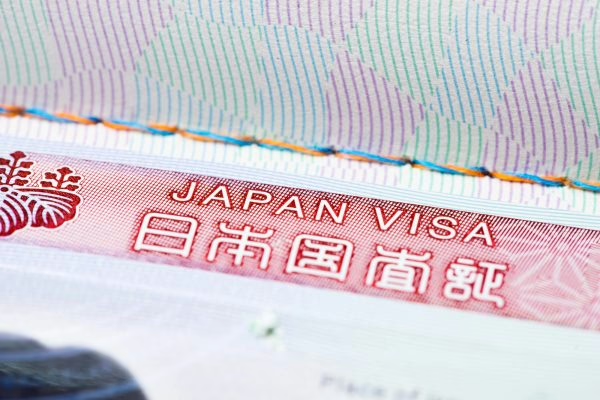
Japan is considering a major overhaul of its migrant labor programs in an effort to better address critical labor shortages in a number of industries.
Long known for its strict immigration policies, Japan has been gradually relaxing visa regulations in recent years as its rapidly aging population puts pressure on the workforce.
The government is particularly concerned about sectors such as manufacturing and transportation, which are struggling to recruit younger Japanese.
The new proposal comes after three consecutive years of record-high numbers of foreign residents.
Under the direction of Prime Minister Sanae Takaichi, the government is reviewing policies related to foreigners, including those who overstay their visas, amid local concerns about the growing numbers.
Newsweek reached out to Japan’s Foreign Ministry by email for comment outside of office hours.
The plan, presented to a panel of experts on Tuesday, would set a cap of 805,700 workers for the Specified Skilled Worker Type 1 (SSW1) program, according to local media, down from the 820,000 figure introduced in March 2024.
The SSW framework is also set to expand, covering 19 industrial fields, including logistics warehouses, linen supply and resource recycling, as well as broader job categories in manufacturing and transportation.
This reduction reflects government estimates of labor-saving benefits from digital technology and projected productivity gains, Nikkei reported.
The government also announced plans to phase out the current Technical Intern Training Program-a system for inexperienced workers to gain skills and, if they meet strict criteria, transition toward longer-term visa status. Critics say the program has often been used as a source of cheap labor.
The 805,700 workers admitted to the new Specified Skilled Worker System, which replaces the SSW and encompasses 19 fields, would be able to work for a renewable three-year period starting in fiscal year 2026.
The government is also considering admitting a maximum 426,200 interns for a two-year period under the Employment for Skill Development Program, which would encompass 17 fields, for about 1.2 million foreign migrant workers in total.
At the end of June, 333,123 people held SSW I status, while about 449,000 were technical interns, according to government data cited by the Japan Times.
The JICA Ogata Research Institute, a think tank run by the government-run Japan International Cooperation Agency, estimated in a 2024 report that Japan will be short 770,000 workers out of the 4.19 million required by 2030, “highlighting the need for foreign human resources (HRs) as new players in socioeconomic development and regional revitalization in Japan.”
Japan’s Cabinet is expected to decide by January. If approved, workers could start being onboarded under the new framework beginning in March 2027.
(Miami Herald)