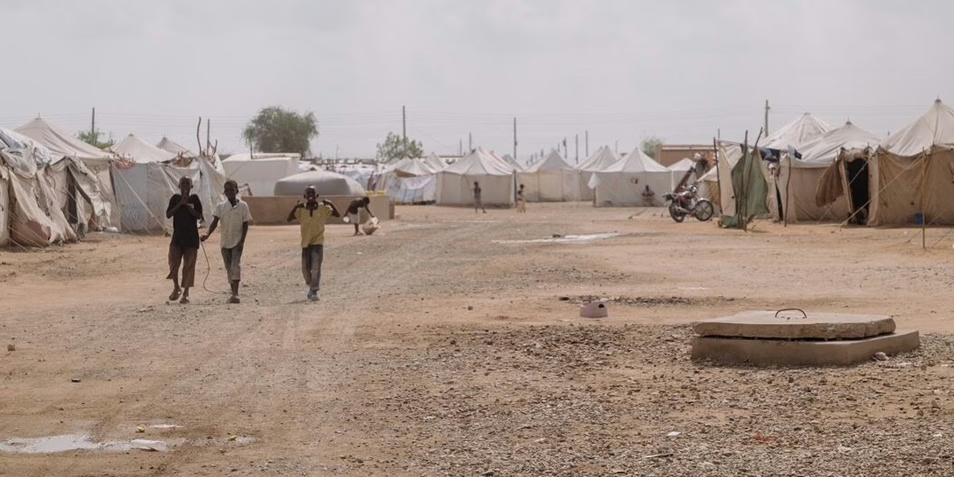
Briefing the Security Council on Monday, senior UN political and humanitarian officials described a sharply deteriorating security and humanitarian situation marked by indiscriminate attacks, expanding territorial gains by the Rapid Support Forces (RSF), and escalating dangers for civilians, aid workers and peacekeepers.
The conflict erupted in April 2023 amid a power struggle between the Sudanese Armed Forces (SAF) and the RSF.
Since then, fighting has spread nationwide, devastating cities, displacing millions and pushing parts of the country, including areas of Darfur, into famine conditions.
Assistant Secretary-General for Political Affairs Khaled Khiari said fears that the dry season would bring intensified fighting had been confirmed.
“Each passing day brings staggering levels of violence and destruction,” Mr. Khiari told ambassadors. “Civilians are enduring immense, unimaginable suffering, with no end in sight.”
In recent weeks, the conflict has centred on the Kordofan region, where the RSF has made significant territorial gains, capturing Babanusa in West Kordofan on 1 December, followed a week later by the seizure of Heglig in South Kordofan, a key oil field and processing hub for South Sudanese crude exports.
Kadugli and Dilling, both in South Kordofan, are now under tightening siege conditions, with shelling and drone strikes continuing.
Reports indicate that SAF personnel withdrew from some areas into South Sudan, while South Sudanese forces moved into Sudan to protect the Heglig oil infrastructure.
“These developments reflect the increasingly complex nature of the conflict and its expanding regional dimensions,” Mr. Khiari warned, cautioning that Sudan’s neighbours could be drawn into a wider war if the situation remains unaddressed.
A particularly alarming trend, UN officials said, is the growing use of drones by both sides. On 4 December, a kindergarten in in Kalogi, South Kordofan was struck, followed by an attack on the hospital treating the victims.
Edem Wosornu, Director of Crisis Response at the UN Office for the Coordination of Humanitarian Affairs (OCHA), said civilian suffering was expanding across multiple fronts, with Kordofan emerging as a new epicentre of humanitarian need.
In addition to targeting civilians, aid workers and convoys were also struck – injuring humanitarians, severely affecting lifesaving programs, and forcing UN agencies and NGOs to relocate staff from several locations due to insecurity.
Meanwhile, conditions in Darfur remain catastrophic.
The UN continues to receive reports of mass killings and sexual violence following the RSF’s takeover of El Fasher earlier this year, including atrocities committed during an April offensive on the Zamzam displacement camp.
As the conflict approaches 1,000 days, both officials urged the Council to act decisively to protect civilians, ensure humanitarian access and push for an immediate cessation of hostilities.
“The Council must send a strong, unequivocal message,” Ms. Wosornu said, “that attacks directed against civilians and violations of international humanitarian law will not be tolerated.”
Mr. Khiari echoed the call, urging international backers of both sides to use their influence to halt the fighting and support a Sudanese-led political process.
“The United Nations is fully committed,” he said, “to working with all international actors to end the violence – for the sake of the people of Sudan and regional stability.
“More than 100 people were killed in this despicable attack, including 63 children,” Mr. Khiari said.
Drone attacks have also directly targeted UN personnel.
On 13 December, strikes hit a UN logistics base in Kadugli, killing six Bangladeshi peacekeepers serving with the UN Interim Security Force for Abyei (UNISFA) and injuring nine others.
UNISFA has launched an investigation under difficult security conditions, while all UN personnel have been evacuated from Kadugli until further notice.
Mr. Khiari stressed that attacks against peacekeepers “may constitute war crimes” and demanded accountability.
(UN News)